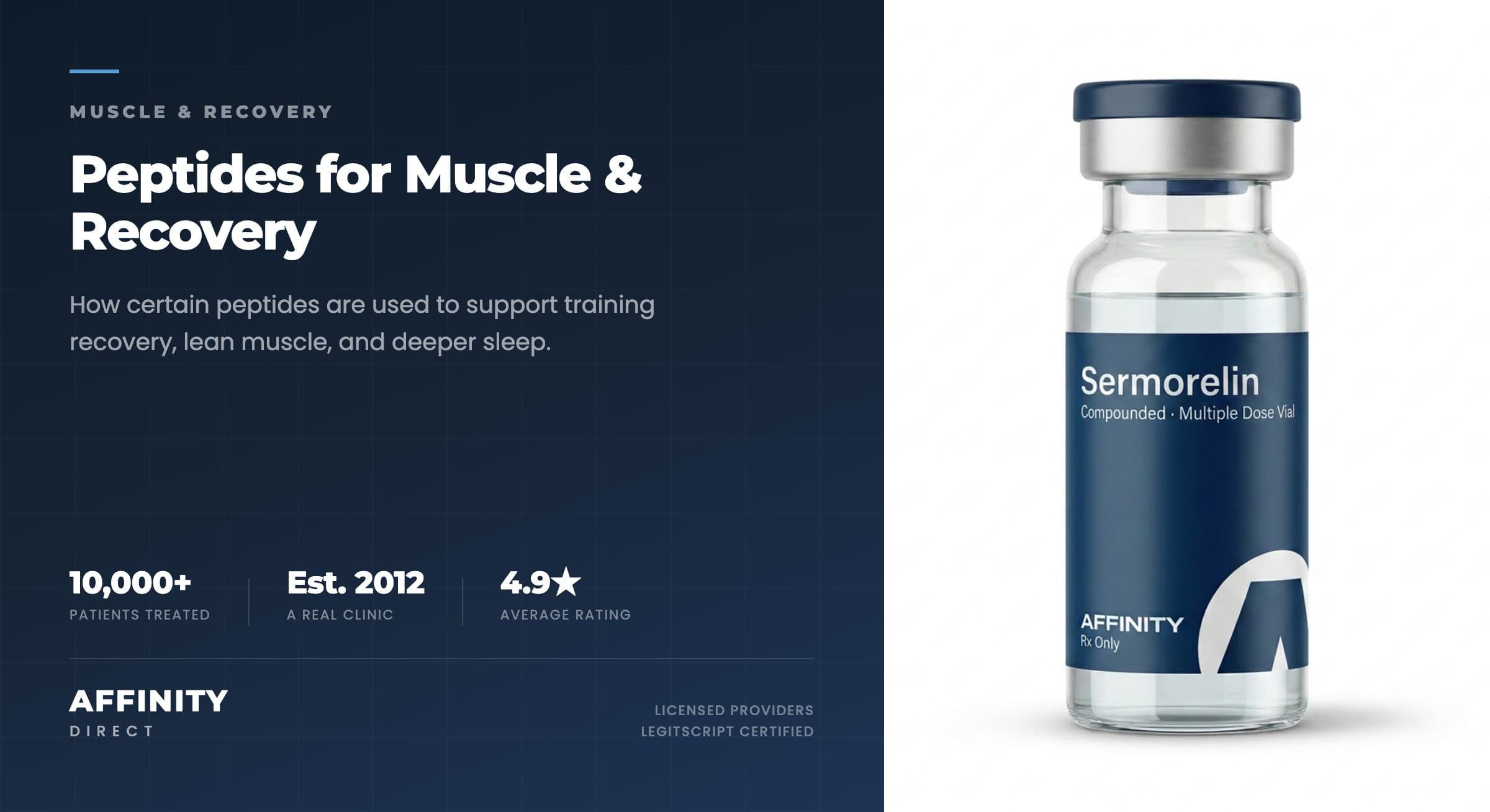
If you train hard, the muscle isn't built in the gym — it's built in the hours afterward, while you sleep, repair tissue, and adapt. That's the window where the conversation about "muscle peptides" actually lives. This article is education, not medical advice: a clinic's honest read on what growth-hormone peptides like sermorelin may do, what the evidence does and doesn't support, and why recovery and sleep matter as much as anything you inject. Only a licensed provider can decide whether any of this is appropriate for you.
A quick, important framing: the peptides discussed here are compounded medications prepared by a licensed U.S. pharmacy and dispensed only after a provider reviews your intake. They are not FDA-approved for muscle building or athletic use, and those uses are off-label. This is a different category entirely from gray-market "research chemical" powders sold online — Affinity Direct is a real clinic established in 2012, not an unregulated reseller.
Why recovery is the real lever for body composition
Muscle growth is a stimulus-and-repair cycle. Resistance training creates the demand; the actual remodeling happens during rest, fed by hormones, protein, and sleep. One of the central players is growth hormone (GH), which your pituitary gland makes and releases naturally. In adults, GH helps maintain normal body structure and metabolism, and low GH in adults is associated with increased body fat and weaker muscles and bones.1 GH doesn't act alone — it works largely through IGF-1, and together the two are described as promoting normal growth of bones and tissues throughout the body.2
Here's the part most people miss: a major nocturnal GH pulse typically follows soon after you fall asleep, and research indicates this release is tied closely to sleep onset — when you delay sleep, the GH peak shifts with it.3 The relationship between deep, slow-wave sleep and GH is an active area of study: in one controlled experiment, deliberately deepening slow-wave sleep was associated with a striking rise in GH secretion compared with a control condition.4 The practical takeaway is unglamorous but real: if your sleep is fragmented, you may be undercutting the exact recovery process you're training to trigger — and no peptide changes that math.
Sermorelin: working with your own growth hormone
Sermorelin is a growth-hormone-releasing hormone (GHRH) analogue. That mechanism matters: rather than putting synthetic growth hormone into your body, sermorelin is designed to signal your own pituitary to release its own GH. It is not HGH and not an injection of synthetic growth hormone — a distinction worth keeping straight when you read marketing copy that blurs the two.
What does the research suggest? In a review of growth-hormone secretagogues in adult men, longer-term sermorelin treatment (about five months) was associated with a statistically significant increase in lean body mass of roughly 1.26 kg, and the broader class of agents was discussed as potentially helping improve body composition.5 That's a meaningful but modest signal — and the same authors are explicit that the evidence base is thin, noting a "paucity of data" and a lack of large, long-term studies in this population.5 In plain terms: research suggests a potential body-composition benefit, but no one can honestly promise a number, a timeline, or a guaranteed result.
Sermorelin is being studied as a way to support the body's own growth-hormone rhythm. It is not a shortcut around training, protein, or sleep — and it is not a substitute for a provider's judgment about whether it's right for you.
Because sermorelin's mechanism is tied to natural GH release — much of which happens at night around sleep onset — the sleep connection above is not a side note. The peptide and the behavior point at the same recovery window. You can learn more on our sermorelin product page, and our sermorelin deep dive walks through the GHRH mechanism in more detail.
Glutathione and oxidative stress after training
Hard training does something useful and something costly at the same time: it drives adaptation, but it also increases oxidative stress — a rise in reactive molecules inside your cells as exercise intensity climbs. Glutathione, a tripeptide your body makes, is often called the body's master antioxidant, and it is described as helping minimize the lipid peroxidation of cell membranes that intense exercise can cause.6 Research on exercise and the glutathione antioxidant system suggests training itself can improve this defense network and support redox balance under load.7
The honest caveat: evidence that supplemental glutathione meaningfully improves performance or recovery in already-healthy, well-trained people is limited and mixed.6 So glutathione is best understood as oxidative-stress support that may complement a recovery routine — not a muscle-builder. If that interests you, see our glutathione page and our overview of glutathione injection benefits.
How these pieces fit together
| Peptide | What it is | Studied / associated with | Regulatory status |
|---|---|---|---|
| Sermorelin | GHRH analogue — signals your own pituitary to release GH | Lean body composition, recovery, sleep quality, bone density | Compounded; adult wellness use is off-label, not FDA-approved |
| Glutathione | Tripeptide; the body's master antioxidant | Oxidative-stress balance after exertion, detox/skin support | Compounded; no FDA-approved injectable wellness indication |
| Sleep itself | Behavior, not a product | The window where most GH is released and tissue repairs | Free — and foundational |
Notice that none of this is a doping or competition story. We're not talking about beating a drug test or chasing supraphysiologic hormone levels — those uses are outside the scope of responsible care, and we don't support them. The framing here is everyday recovery, body composition, and sleep for adults who train. For the full menu and how the program works, start at the peptide therapy hub or take the 60-second match quiz to see which option a provider might consider for your goals.
What peptides can't do
Set expectations honestly, because the brands that won't are the ones to distrust. Peptides do not replace progressive resistance training, adequate protein, or consistent sleep — at best they may support a routine that already has those fundamentals in place. The body-composition signals in the research are modest and develop over months, not weeks, and individual results vary.5 No peptide diagnoses, treats, cures, or prevents any disease, and no one — including us — can guarantee a specific outcome. The right first move is a conversation with a licensed provider who can weigh your history. If you want to compare options first, our recovery overview sits alongside guides like our full peptide therapy guide.
Common questions
Is sermorelin the same as HGH?
No. Sermorelin is a GHRH analogue designed to signal your pituitary to release your own growth hormone; it is not an injection of synthetic human growth hormone.1 The distinction matters clinically and legally, which is part of why these therapies require a provider's review. Sermorelin is a compounded medication and its adult wellness use is off-label.
Will peptides build muscle on their own?
No. Research suggests growth-hormone secretagogues like sermorelin may support modest improvements in lean body mass over months, but the evidence is limited, and any effect rides on top of training, protein, and recovery — not in place of them.5
Why does everyone keep talking about sleep?
Because a major growth-hormone pulse is released around the time you fall asleep, with the timing tied closely to sleep onset.3 Research also suggests that deepening slow-wave sleep can substantially increase GH secretion.4 Recovery and sleep are the foundation any peptide is meant to support, not replace.
How do I find out if peptide therapy is right for me?
Complete a short online intake; a licensed provider reviews it, usually within 24 hours, and prescribes a compounded peptide only if it's appropriate. You're charged at checkout with a full refund if a provider doesn't approve treatment, and every order ships free with syringes and alcohol prep pads. Start with the match quiz or read how to get peptide therapy online.
This article is for general education and is not medical advice. These statements have not been evaluated by the FDA. These products are not intended to diagnose, treat, cure, or prevent any disease. Compounded medications require a valid prescription from a licensed provider. For investigational/wellness use only. Talk with a licensed Affinity Direct provider about whether peptide therapy is right for you.