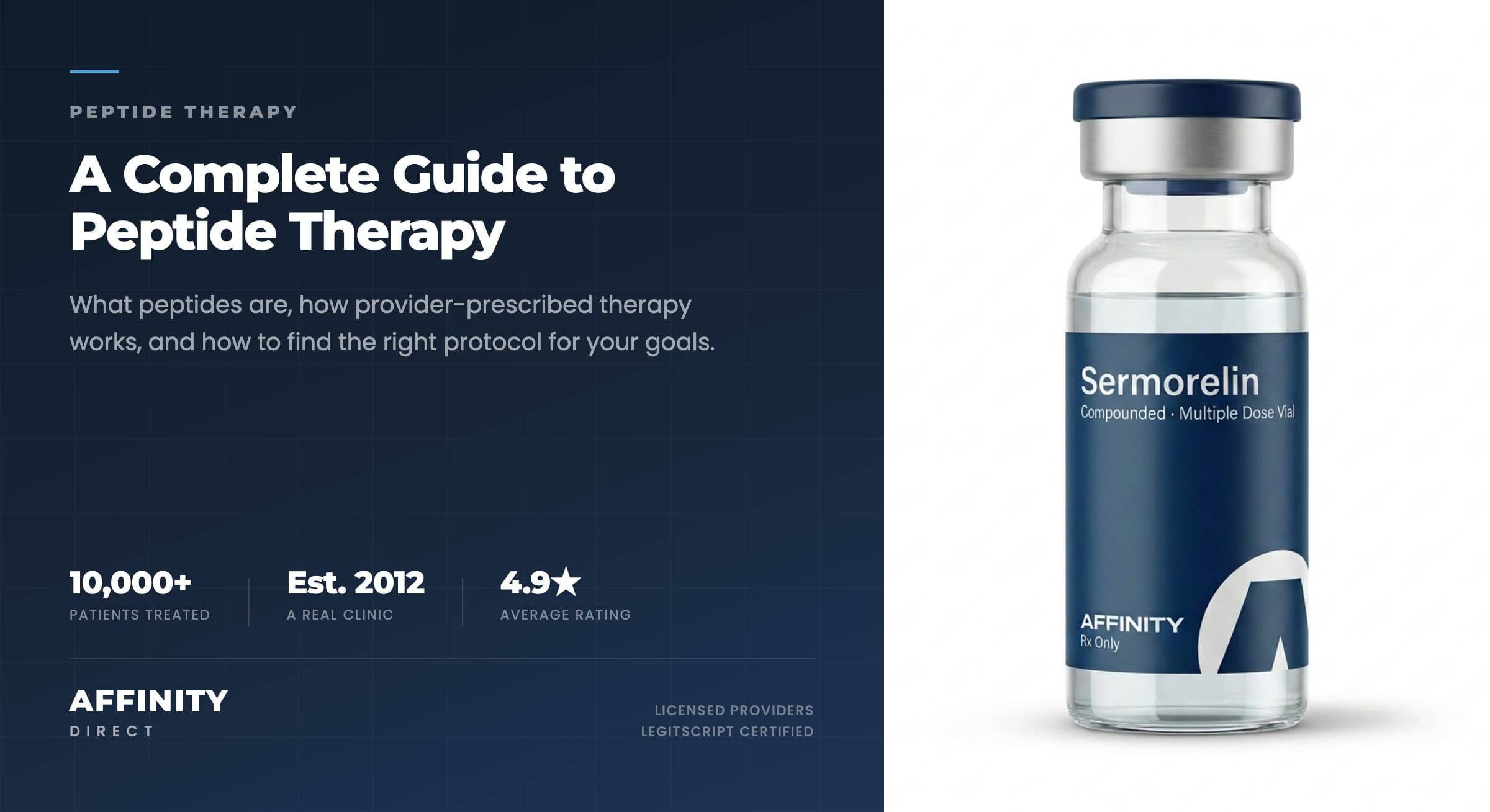
"Peptide therapy" has moved from biohacker forums into ordinary conversations about energy, recovery, sleep, and aging. But the term gets used loosely, and a lot of what circulates online is hype attached to gray-market products of unknown origin. This guide is the plain-spoken, clinical version: what peptides actually are, what provider-prescribed peptide therapy means, who it may be a fit for, and an honest overview of the five peptides Affinity Direct offers. This is educational information, not medical advice — a licensed provider should evaluate whether any treatment is appropriate for you.
What is a peptide?
A peptide is a short chain of amino acids — the same building blocks that make up proteins — linked by chemical bonds. By the common definition, a peptide is a string of roughly 2 to 50 amino acids; once a chain grows longer, scientists generally call it a polypeptide or protein instead.1 So peptides are small, specialized fragments of the same material your body uses to build everything from muscle to hormones.
Your body makes thousands of its own peptides, and many act as signaling molecules — short messages that tell cells what to do. Some regulate hormones, some influence inflammation, and some serve as raw material for larger structural proteins. In skin care, for example, peptides are studied for their potential to supply building blocks for collagen and elastin, though experts note that the science of using them effectively is genuinely tricky.2 That signaling role is the whole idea behind peptide therapy: introduce a specific peptide and, in theory, nudge a specific biological pathway.
What does "peptide therapy" mean?
Peptide therapy is the use of a specific peptide — usually as a small subcutaneous injection — with the goal of supporting a targeted function in the body, such as recovery, energy metabolism, or hormone signaling. The peptides used in legitimate clinical settings are compounded by a licensed U.S. pharmacy and require a valid prescription after a provider reviews your health history.
This is the most important distinction to understand. There is a wide world of "research chemical" peptides sold online with disclaimers like "not for human consumption," made by unaccountable sources with no oversight. Affinity Direct does not operate that way. We are a real Midwest clinic network established in 2012, and our peptides are dispensed only after a licensed provider reviews your intake and writes a prescription, then compounded by a licensed 503A compounding pharmacy. If a provider doesn't approve treatment, you're fully refunded.
Compounded and off-label: the honest version
Most peptides used in wellness-oriented therapy are compounded medications, and that comes with caveats you deserve to hear up front. Compounded drugs are not FDA-approved: the FDA does not review them for safety, effectiveness, or quality before marketing the way it does for mass-manufactured drugs.7 Compounding exists for a legitimate reason — it lets a pharmacy tailor a medication to an individual when an approved product doesn't fit — and the literature emphasizes it should generally be used when an approved option isn't available and the benefits are judged to outweigh the risks.7
Many peptide uses are also off-label, meaning the peptide is used for a purpose other than a narrow FDA-approved indication (or has no approved indication at all). Off-label prescribing is common and legal, but it places more responsibility on the prescriber to weigh the evidence — which is why peptide therapy belongs with a provider who knows your history, not an anonymous online cart. A real clinic also means dose questions, follow-up, and accountability, rather than a one-time checkbox.
Who might consider peptide therapy?
Peptide therapy tends to appeal to adults who are generally healthy and focused on wellness goals: better recovery from training, daytime energy, sleep quality, skin appearance, body composition as an adjunct to lifestyle changes, or desire and intimacy. It is not a treatment for any specific disease, and no peptide should be presented as a cure. The right starting point is an honest conversation about your goals and health history with a licensed provider, who can tell you whether a given peptide may be reasonable for you — or whether something else makes more sense.
Peptide therapy through Affinity Direct is available to patients in all 50 states. In Ohio, Indiana, Illinois, Arizona and Pennsylvania your intake is reviewed by the Affinity Whole Health clinic network; everywhere else it is reviewed by a licensed provider in your own state, to the same standards. The fastest way to see what might fit is our 60-second match quiz, which routes your answers to a provider for review.
The five peptides Affinity Direct offers
We keep our menu deliberately focused. These are the only five peptides we offer — we don't sell GLP-1 weight-loss drugs, BPC-157, or the long tail of compounds on gray-market sites. Here's a clear-eyed summary of each, with what research associates it with and what it costs.
| Peptide | What it is | Studied / associated with | From |
|---|---|---|---|
| Glutathione | The body's "master" antioxidant tripeptide3 | Oxidative-stress balance, skin brightness, liver/detox and immune support | $169 |
| Sermorelin | A GHRH analogue signaling your own growth hormone4 | Lean body composition, recovery, sleep, bone density | $219 |
| NAD+ | A coenzyme central to cellular energy5 | Cellular energy, mitochondria, longevity pathways, DNA repair | $219 |
| MIC + B12 | A lipotropic blend plus vitamin B12 | Adjunct to a nutrition + exercise weight program | $349 |
| PT-141 | A melanocortin-receptor agonist acting in the brain6 | Sexual desire (a different pathway than ED pills) | $219 |
Glutathione
Glutathione is a low-molecular-weight tripeptide (glutamate–cysteine–glycine) that the scientific literature describes as one of the most important natural antioxidants and the main cellular "redox buffer."3 It is associated with oxidative-stress balance, detoxification through conjugation of compounds for elimination, and immune and skin support.3 Injectable glutathione for these wellness uses is compounded and off-label. Learn more on the glutathione page or in our deep dive on glutathione injection benefits.
Sermorelin
Sermorelin is a 29–amino acid analogue of growth-hormone-releasing hormone (GHRH) — the shortest synthetic peptide with full GHRH activity — that signals the anterior pituitary to release your body's own growth hormone.4 To be precise: sermorelin is not synthetic HGH. Its original FDA approval was as a pediatric diagnostic and treatment tool for growth hormone deficiency in children;4 adult wellness and anti-aging use is off-label and compounded. Research associates it with lean body composition, recovery, and sleep quality. See the sermorelin page or sermorelin therapy benefits.
NAD+
NAD+ (nicotinamide adenine dinucleotide) is a coenzyme at the center of how cells make energy. The NIH notes it is primarily involved in transferring the energy in carbohydrates, fats, and proteins to ATP, and that more than 400 enzymes require it — more than any other vitamin-derived coenzyme — with additional roles in genome maintenance and gene expression.5 NAD+ levels are thought to decline with age, which is why it shows up in longevity conversations — but many of those claims rest on early or preclinical research, so it's worth being especially cautious about expectations. Injectable use is off-label and compounded. More on the NAD+ page.
MIC + B12
MIC + B12 is a lipotropic blend of Methionine, Inositol, and Choline plus vitamin B12. It's used as an adjunct to a structured weight-management program built on nutrition and exercise — not as a standalone weight-loss drug, and not a substitute for the GLP-1 medications it's sometimes confused with. The evidence here is limited, and it's an off-label compounded combination. Details on the MIC + B12 page.
PT-141 (Bremelanotide)
PT-141, or bremelanotide, is a melanocortin-receptor agonist that acts in the brain — a fundamentally different mechanism than ED pills, which work on blood flow. It is the active ingredient in Vyleesi, which the FDA approved for premenopausal women with acquired, generalized hypoactive sexual desire disorder (HSDD); notably, the label states the exact mechanism by which it improves HSDD is unknown.6 Use in men or for general libido is off-label, and Affinity offers it compounded. See the PT-141 page.
How to get started
Getting peptide therapy through Affinity Direct is built to be straightforward and discreet — no waiting room, no awkward in-person conversation:
- Take the 60-second quiz. The match quiz asks about your goals and health history.
- A licensed provider reviews your intake — a free medical review, usually within 24 hours. You're charged at checkout, and if a provider doesn't approve treatment, you're fully refunded.
- If approved, your prescription is compounded by a licensed U.S. pharmacy and shipped with free 2-day discreet delivery. Every order includes syringes and alcohol prep pads.
No subscription is required — buy one time at the price shown, or take an optional 15% off with Subscribe & Save and cancel any time. Browse everything on the peptides hub, or read our related guides on whether peptides are safe and legal and how to get peptide therapy online.
Common questions
Are peptides the same as steroids or HGH?
No. Steroids and synthetic human growth hormone (HGH) are different categories of substances. The peptides we offer are not anabolic steroids, and sermorelin in particular is not HGH — it's a GHRH analogue that signals your own pituitary to release growth hormone rather than replacing it directly.4
Are these peptides FDA-approved?
The compounded peptides used in wellness-oriented therapy are generally not FDA-approved, and the FDA does not review compounded medications for safety, effectiveness, or quality before marketing.7 PT-141's active ingredient is FDA-approved as Vyleesi for a narrow indication (HSDD in premenopausal women); other uses are off-label.6 We think you should know this clearly before you start.
Do I need a prescription?
Yes — and we handle it. A licensed provider reviews your intake and decides whether a prescription is appropriate. That provider relationship is the difference between clinic-dispensed, pharmacy-compounded peptides and unregulated gray-market products.
Which peptide is right for me?
That depends on your goals and health history, which is exactly what a provider evaluates. The fastest way to narrow it down is the match quiz — and the final call always rests with a licensed provider, not a website. For cost specifics across all five, see our breakdown of peptide therapy cost.
This article is for general education and is not medical advice. These statements have not been evaluated by the FDA. These products are not intended to diagnose, treat, cure, or prevent any disease. Compounded medications require a valid prescription from a licensed provider. For investigational/wellness use only. Talk with a licensed Affinity Direct provider about whether peptide therapy is right for you.