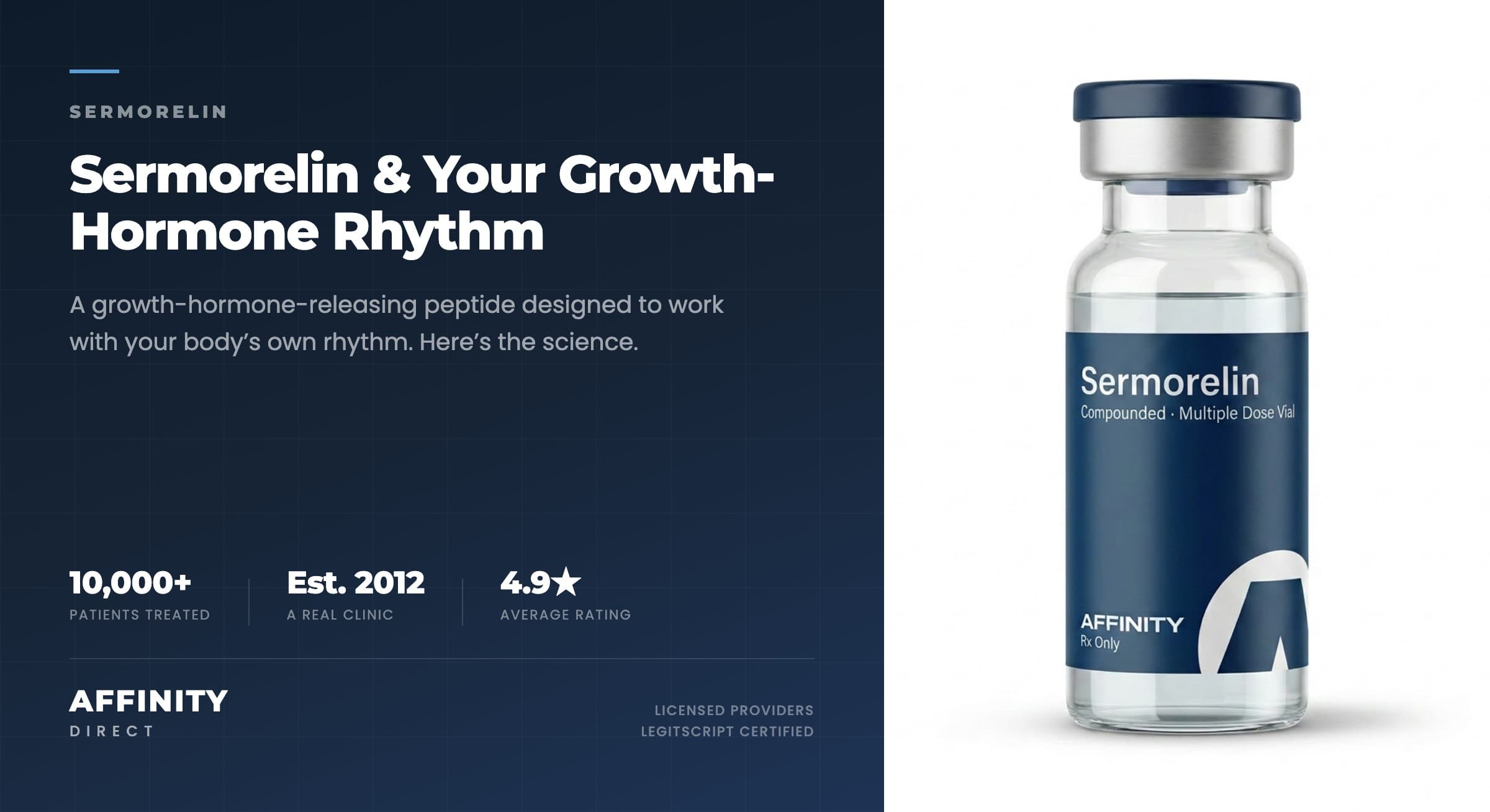
Sermorelin sits in an unusual category among peptides: it is not a hormone you add to your body, but a signal that asks your body to do something it already knows how to do. Instead of injecting synthetic growth hormone, sermorelin is thought to nudge your own pituitary gland to release its own growth hormone — on its own schedule, under its own controls. That single distinction shapes how it works and who it may suit. This article is educational and is not medical advice; whether sermorelin is appropriate for you is a decision for a licensed provider.
What sermorelin actually is
Sermorelin is a growth-hormone-releasing hormone (GHRH) analogue. Your body naturally makes GHRH in the hypothalamus, and it is the messenger that signals the pituitary gland to release growth hormone. Sermorelin is a synthetic version of the active core of that messenger — a 29-amino-acid analogue described as “the shortest synthetic peptide with full biological activity of GHRH.”1 In other words, it is the smallest fragment that still carries the full activity of the natural hormone.
Mechanically, sermorelin binds to the growth-hormone-releasing-hormone receptor (GHRHR) on the pituitary, “mimicking the effects of the full-length GHRH in promoting growth hormone secretion.”2 The key idea worth holding onto: sermorelin acts upstream of growth hormone rather than serving as a replacement for it.
Sermorelin vs. HGH: the difference that matters
This is the most common — and most important — point of confusion. Synthetic HGH (human growth hormone, such as somatropin) is the finished hormone itself, injected directly to raise growth hormone from the outside in. Sermorelin is thought to work in the opposite direction: it signals the pituitary so your body produces and releases its own growth hormone from the inside out.1
One practical consequence often raised is the body’s own regulatory brake. Growth hormone release is limited by a counter-signal called somatostatin. Because sermorelin works through the pituitary rather than around it, that feedback loop is described as staying intact — sermorelin’s effects are “regulated by negative feedback through the inhibitory hormone somatostatin, making it difficult to overdose, unlike exogenous rhGH.”2 Sermorelin is not HGH, and it should not be described as a way to flood the body with growth hormone.
| Feature | Sermorelin (GHRH analogue) | Synthetic HGH (somatropin) |
|---|---|---|
| What it is | A signal that prompts GH release | The growth hormone itself |
| Where it acts | The pituitary gland | Directly in the body |
| Body’s feedback loop | Described as preserved (somatostatin still applies)2 | Bypassed |
| Release pattern | Pulsatile, the body’s own rhythm | Externally dosed |
Why the body’s own rhythm matters
Growth hormone is not released in a steady drip. In a healthy adult, the largest pulse is tied to sleep — specifically to slow-wave (deep) sleep in the first hours of the night.3 Because sermorelin is thought to signal through the pituitary rather than override it, the growth hormone it prompts would be released in the body’s natural pulses rather than as a constant external level. In the studied pediatric protocols, sermorelin was given at bedtime, aligning with that nightly window.1
Preserving that natural pattern is part of the rationale often discussed for GHRH peptides — and the pulsatile, feedback-controlled rhythm is exactly what tends to fade with age.
What declines with age — and what sermorelin is studied alongside
Growth hormone output falls steadily through adult life — by about 15% per decade after the third decade — a shift sometimes called somatopause.4 The decline tracks closely with the loss of deep sleep. In one well-known study, slow-wave sleep dropped from nearly 20% of the night in men under 25 to less than 5% in men over 35, and growth hormone secretion fell by roughly 75% over that same span.3
What does that decline tend to look like? Reduced growth hormone secretion in adults is associated with increased body fat (especially visceral fat), reduced muscle mass, decreased deep sleep, and changes in memory and cognitive function.4 This is the backdrop against which sermorelin’s studied associations are usually discussed:
- Body composition — growth hormone signaling is associated with body composition; research on raising GH has shown reductions in fat mass and increases in lean body mass, though notably without consistent gains in measured strength.4
- Recovery — growth hormone’s role in the body’s tissue physiology is why recovery is a commonly discussed area of interest.
- Sleep quality — given the tight link between deep sleep and GH release, sleep is frequently a focus of patient interest.3
- Body fat and lean mass — the metabolic shifts associated with low GH are part of why these areas come up.4
An honest framing: these are associations drawn from growth hormone physiology and from limited human research on GHRH peptides. They are not guarantees of any specific result, and sermorelin should not be described as something that treats, cures, or reverses aging or any disease. It is being studied and used as a way to support the body’s own growth hormone system — that is the appropriately measured claim. For the broader picture, our guide to peptides for muscle and recovery covers it in more depth.
FDA status: approved once, off-label now, and compounded
Sermorelin has a real regulatory history, and transparency here matters. It was FDA-approved in 1997 — but for a narrow purpose: as a treatment for children with growth hormone deficiency or growth failure, and as a diagnostic agent to assess GH secretion.2 As a diagnostic test, the response to intravenous sermorelin was described as “a rapid and relatively specific test for the diagnosis of growth hormone deficiency.”1 The original branded product was later discontinued for commercial reasons, and as of 2008 it is no longer available as an FDA-approved drug.2
So when sermorelin is used today for adult wellness, recovery, sleep, or body-composition goals, that use is off-label, and the product is a compounded medication prepared by a licensed U.S. compounding pharmacy — not an FDA-approved drug for these purposes. That is also what separates a legitimate, provider-prescribed peptide from unregulated gray-market “research chemicals.” Affinity Direct is a real clinic: sermorelin is dispensed only after a licensed provider reviews your intake and writes a prescription, and it is compounded by a licensed pharmacy — never sold as an over-the-counter or “not for human use” product.
Who sermorelin may suit — and who should be cautious
People who explore sermorelin are typically adults noticing changes that can accompany declining growth hormone: slower recovery, lighter sleep, shifts in body composition despite consistent effort. Because it is thought to preserve the body’s feedback controls, some clinicians consider it a more measured starting point for discussion than direct HGH.2
It is not for everyone. Sermorelin is generally not considered appropriate during pregnancy or breastfeeding, and anyone with a history of cancer, active malignancy, or certain endocrine conditions needs careful provider evaluation before considering any therapy that influences growth hormone. This is why the process runs through a licensed provider, not a checkout button alone — the evaluation is the point. We do not provide dosing or self-administration instructions here; your provider determines what, if anything, is appropriate.
How to find out if it’s right for you
If you’re weighing sermorelin, the most useful next step is a real clinical evaluation. You can read the full product details on our sermorelin therapy page, take the 60-second peptide match quiz to see which option may fit your goals, or browse all five options on the peptide therapy hub. If energy and daytime focus rank higher than recovery, NAD+ may be worth comparing too. For the bigger picture on safety and what compounded peptide therapy involves, start with our complete guide to peptide therapy.
Every Affinity Direct peptide order is reviewed by a licensed provider — usually within 24 hours — and you are charged at checkout with a full refund if a provider decides treatment isn’t appropriate. Orders ship free in discreet packaging, with syringes and alcohol prep pads included.
Common questions
Is sermorelin the same as HGH?
No. HGH is the finished growth hormone, injected directly. Sermorelin is a GHRH analogue thought to signal your own pituitary to release your own growth hormone, which is described as keeping the body’s natural feedback controls (via somatostatin) in place.2 They are fundamentally different approaches.
Is sermorelin FDA-approved?
It was FDA-approved in 1997 for children with growth hormone deficiency and as a diagnostic agent, but the branded product was discontinued and as of 2008 is no longer available as an FDA-approved drug.2 Adult wellness use is off-label, and Affinity offers it as a compounded medication prescribed after a provider review — not an FDA-approved product for these uses.
Why is sermorelin often taken at night?
The body’s largest natural pulse of growth hormone is tied to deep, slow-wave sleep early in the night, and that GH release declines along with deep sleep as we age.3 In the studied protocols, sermorelin was given at bedtime to align with that natural window.1 Your provider determines the appropriate approach for you.
What results can I expect from sermorelin?
No specific outcome can be promised. The studied associations — body composition, recovery, sleep quality, and the metabolic effects of growth hormone — come from growth hormone physiology and limited human research, and individual responses vary.4 Sermorelin is being studied to support the body’s own growth hormone system, not to cure or reverse any condition. A licensed provider can give you a realistic, personalized picture.
This article is for general education and is not medical advice. These statements have not been evaluated by the FDA. These products are not intended to diagnose, treat, cure, or prevent any disease. Compounded medications require a valid prescription from a licensed provider. For investigational/wellness use only. Talk with a licensed Affinity Direct provider about whether peptide therapy is right for you.