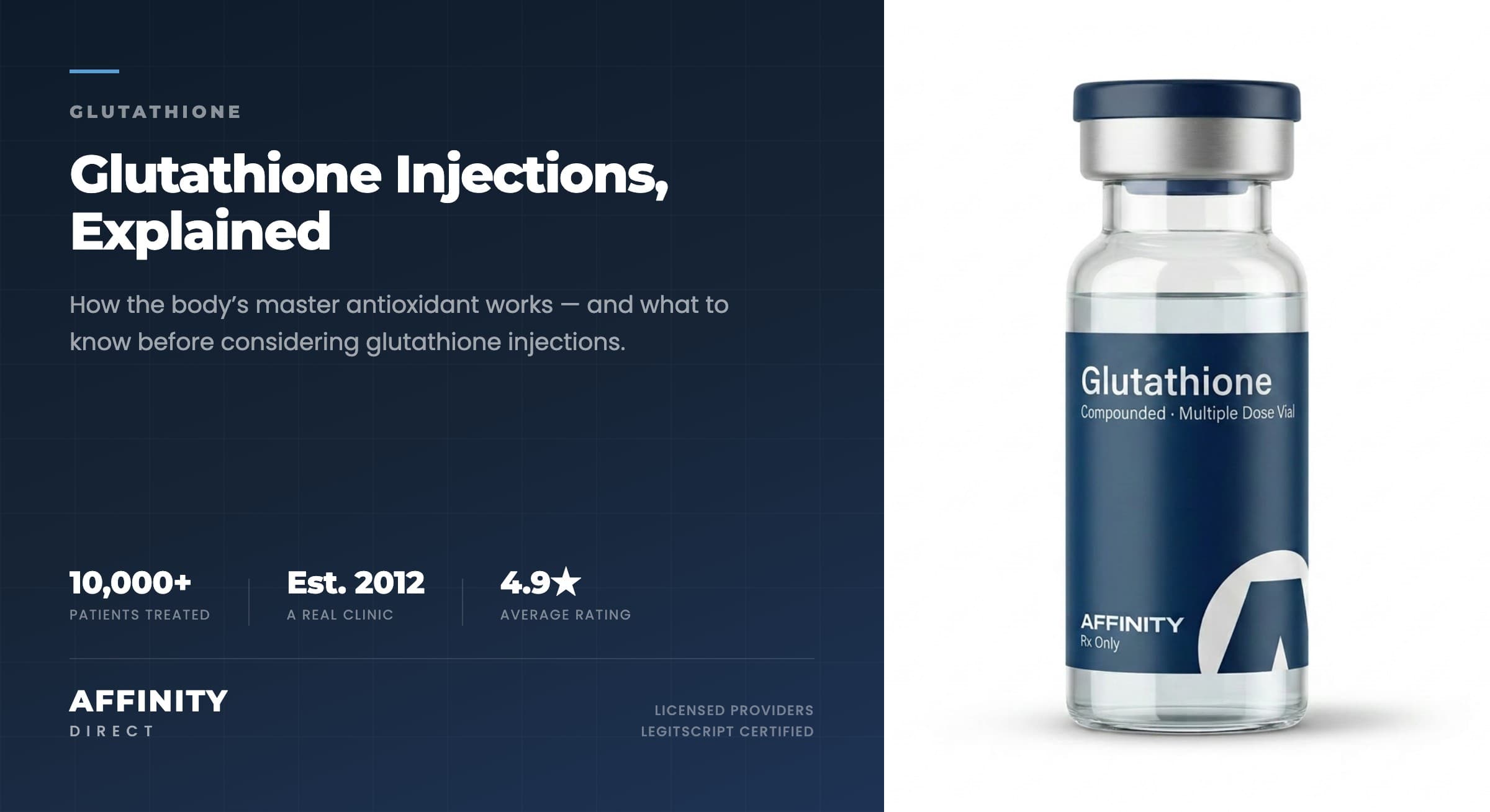
Glutathione gets called the body’s "master antioxidant" so often that the phrase has lost some meaning. So let’s be specific. Glutathione is a small molecule your cells make and use constantly to manage oxidative stress, recycle other antioxidants, and help the liver clear toxins. This article is education, not medical advice — it explains what glutathione does, what the research actually supports, and how the different delivery forms compare, so you can have a more informed conversation with a licensed provider.
What glutathione actually is
Glutathione is a tripeptide — a chain of three amino acids: glutamate (glutamic acid), cysteine, and glycine.1 Your body synthesizes it inside nearly every cell, with the highest concentrations found in the liver.4 Because the body makes its own supply, glutathione is not a vitamin you must get from food; it is an endogenous compound your cells build and continuously recycle.
The working part of the molecule is a sulfur-containing sulfhydryl (–SH) group on the cysteine. That thiol group is what lets glutathione neutralize free radicals and reactive oxygen species, the unstable molecules produced by normal metabolism, pollution, and physical stress.1 Glutathione cycles between a "reduced" active form (GSH) and an "oxidized" spent form (GSSG); the ratio between the two is one of the most-used lab markers of a cell’s oxidative-stress balance.1
How glutathione works in the body
Three roles come up again and again in the research literature.
- Direct antioxidant. Glutathione donates electrons to quench free radicals and reactive oxygen species, helping protect DNA, proteins, and cell membranes from oxidative damage.1
- Antioxidant recycler. It helps regenerate other antioxidants, including vitamins C and E, back into their active forms — which is part of why it’s described as "master."1
- Detox conjugator. In the liver, glutathione is a central Phase II detoxification molecule: enzymes called glutathione S-transferases attach it to fat-soluble toxins and drug byproducts, making them water-soluble so the body can excrete them.4
Glutathione stores can be drawn down by aging, illness, certain medications, and sustained oxidative stress.1 That decline is one reason wellness clinics offer supplemental glutathione — though, importantly, raising a lab value is not the same as producing a specific health outcome, and the research below is more nuanced than the marketing.
The research-backed associations
Oxidative-stress balance
This is glutathione’s best-established function. As the body’s primary intracellular antioxidant, it is directly involved in neutralizing reactive oxygen species and maintaining redox balance.1 Whether supplementing glutathione meaningfully changes oxidative-stress markers in a given person depends heavily on the delivery form and the individual — which is exactly why this is a provider conversation, not a self-prescribed one.
Skin brightness and tone
Glutathione is widely marketed for "skin brightening," and there is a plausible mechanism: it may inhibit tyrosinase, the rate-limiting enzyme in melanin production, and may shift pigment synthesis toward lighter pheomelanin.3 But the evidence is genuinely mixed. One laboratory study found that plain glutathione (GSH) by itself had no inhibitory effect on melanin production or intracellular tyrosinase activity, while a chemically modified ester form did — suggesting unmodified GSH may struggle to reach the pigment-producing machinery inside skin cells.3 The honest takeaway: glutathione is associated with skin-tone effects in some studies, but it is not a proven, guaranteed skin-lightening treatment, and results vary. If skin appearance is your main goal, our peptides for skin and anti-aging guide walks through the bigger picture.
Liver and detoxification support
The liver holds the body’s highest glutathione concentrations and depends on it for Phase II detox.4 A textbook example is acetaminophen (Tylenol): the liver converts a fraction of each dose into a toxic byproduct called NAPQI, which glutathione neutralizes by conjugation — when glutathione runs low, that protection fails, which is the basis of acetaminophen toxicity.4 Glutathione content also shifts measurably across liver diseases.4 This is real biochemistry; it is not a claim that glutathione "detoxes," "cleanses," or treats any liver condition. It does not.
Immune support
Glutathione is thought to play a role in immune-cell function. Research reviews describe immune cells, particularly lymphocytes, as sensitive to their internal glutathione levels, with T-cell activation and proliferation among the functions affected by glutathione availability.5 Much of this work is laboratory and animal research, so it points to a supporting role rather than a treatment for any infection or immune disease.
Oral vs IV vs subcutaneous injection
How glutathione is delivered matters a great deal, because the molecule is fragile in the digestive tract.
| Form | How it’s taken | What the research suggests |
|---|---|---|
| Oral (capsule/tablet) | By mouth, swallowed | Largely broken down by digestive enzymes before absorption; in one crossover trial, oral GSH did not raise — and in places decreased — plasma glutathione during supplementation.2 |
| Sublingual | Dissolved under the tongue | Bypasses some first-pass breakdown; in the same trial it raised total and reduced glutathione and improved the GSH/GSSG ratio versus oral.2 |
| Injection (subcutaneous) / IV | Provider-prescribed, into fat tissue or a vein | Bypasses the digestive tract entirely, delivering glutathione directly to circulation — the rationale behind clinic-administered injectable and IV forms.2 |
The core problem with oral glutathione is that the tripeptide is partially hydrolyzed and oxidized during digestion before it can reach the bloodstream.2 Injectable and IV routes sidestep that by entering circulation directly. The practical difference between subcutaneous injection and IV is convenience and setting: a subcutaneous injection is a small, at-home shot, while IV therapy requires a clinic visit and an infusion. Both should be prescribed and dosed by a licensed provider — we do not provide dosing or self-injection instructions here.
Who it may suit — and an important safety note
People exploring glutathione are typically interested in antioxidant support, skin appearance, or general wellness as part of a broader healthy-living routine. It is not a diagnosis, treatment, cure, or preventive for any disease, and it is not a substitute for sleep, nutrition, and exercise.
A few things to know before considering injectable glutathione:
- It’s compounded and off-label. Affinity’s injectable glutathione is prepared by a licensed U.S. compounding pharmacy. There is no FDA-approved injectable glutathione for these wellness uses, so this is an off-label, compounded medication — which is a normal category of care, but one you should understand going in.
- Source matters more than almost anything. The biggest documented risks with injectable glutathione have come from contaminated or improperly compounded product, not the molecule itself. That is the entire difference between a provider-prescribed, pharmacy-compounded medication and gray-market "research chemical" vials sold online — and it’s why we only dispense through a licensed pharmacy after a provider reviews your intake.
- Watch for warning signs. As with any injection, stop and contact a clinician if you notice signs of an allergic reaction (rash, hives, swelling, trouble breathing), or significant pain, redness, warmth, or swelling at the injection site. These are reasons to seek prompt medical attention, not to push through.
Whether glutathione is appropriate for you — and which delivery form — is a question for a licensed provider who has reviewed your health history.
How Affinity Direct does it
Affinity Direct is the online arm of Affinity Whole Health, a Midwest clinic network established in 2012 with four locations and more than 10,000 patients treated. If you’re curious whether glutathione fits your goals, the simplest start is our 60-second match quiz, or you can read the full details on the glutathione page. A licensed provider reviews your intake — usually within 24 hours — and prescribes only if it’s appropriate. You’re charged at checkout with a full refund if a provider doesn’t approve treatment, and every approved order ships free in discreet 2-day packaging with syringes and alcohol prep pads included.
Glutathione is one of five peptides and injectables we offer. To see how it fits alongside the others — like NAD+ for cellular energy or sermorelin for recovery and body composition — start at the peptide therapy hub or read our complete guide to peptide therapy.
Common questions
Is glutathione a peptide?
Technically it’s a tripeptide — three amino acids (glutamate, cysteine, glycine) joined together.1 It’s smaller than the signaling peptides people usually mean by "peptide therapy," but it’s grouped with them because it’s an injectable, amino-acid-based compound.
Why would someone choose an injection over an oral supplement?
Because oral glutathione is largely broken down in the digestive tract before it reaches the bloodstream.2 Injectable and IV forms bypass digestion and deliver glutathione directly into circulation, which is the reasoning behind clinic-administered and prescribed injectable forms.2 A provider can advise which route makes sense for you.
Will glutathione lighten my skin?
It may influence skin tone by inhibiting tyrosinase and shifting melanin production, but the evidence is mixed and a specific result can’t be promised.3 One lab study even found unmodified glutathione had no effect on melanin or tyrosinase on its own.3 Treat any "skin whitening" guarantee with skepticism.
Is injectable glutathione FDA-approved?
No. There is no FDA-approved injectable glutathione for antioxidant, skin, or detox uses, so it is provided as a compounded, off-label medication. That’s why it requires a prescription and should only come from a licensed pharmacy after a provider reviews your intake — never from unregulated online sources.
This article is for general education and is not medical advice. These statements have not been evaluated by the FDA. These products are not intended to diagnose, treat, cure, or prevent any disease. Compounded medications require a valid prescription from a licensed provider. For investigational/wellness use only. Talk with a licensed Affinity Direct provider about whether peptide therapy is right for you.