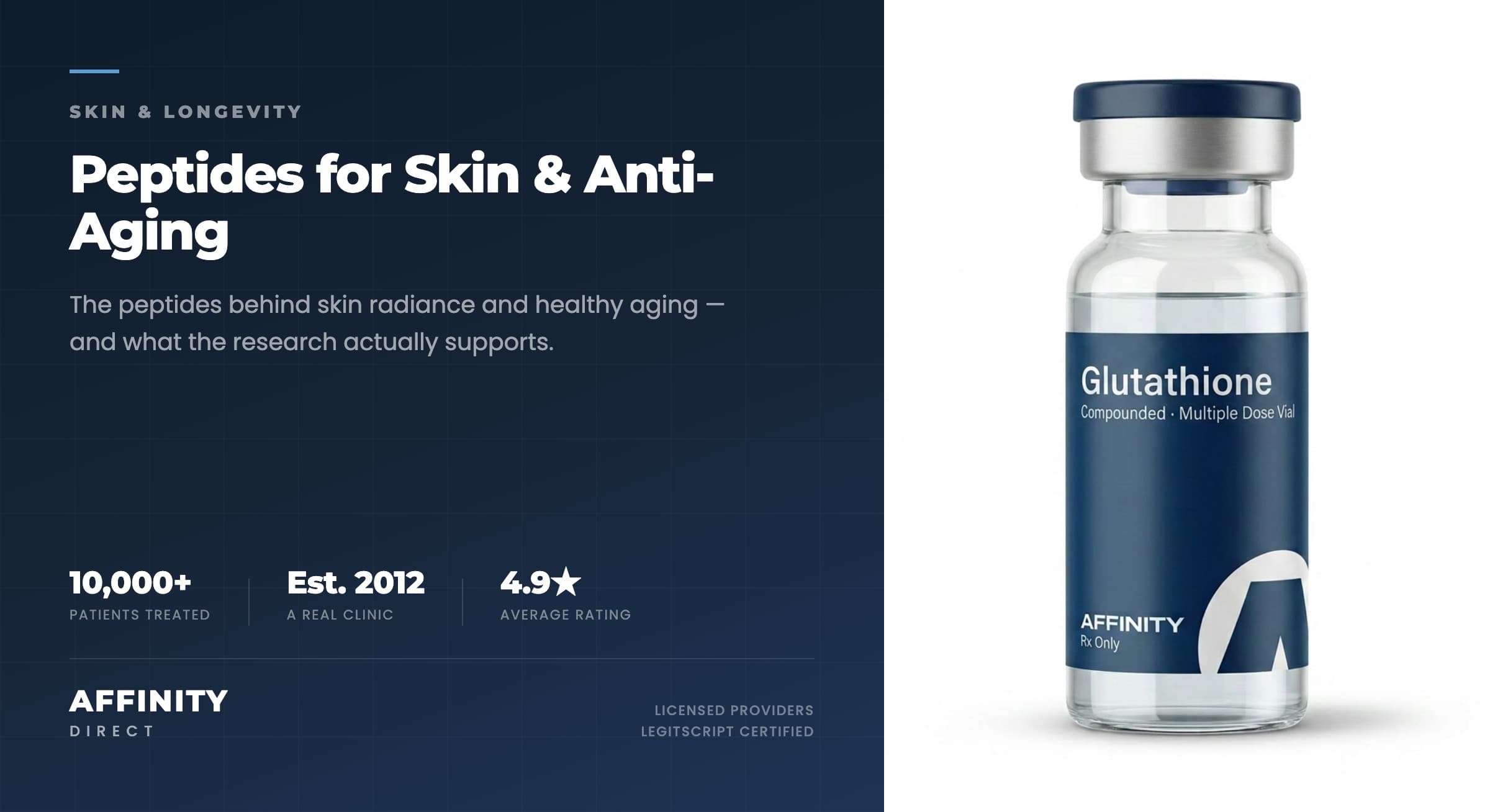
If you have read anything about "anti-aging peptides," you have probably seen a lot of confident promises and very little careful science. This guide takes the opposite approach. We will walk through the two compounds Affinity Direct offers that are most often discussed for skin and healthy aging — glutathione and NAD+ — explain the biology in plain language, and be honest about where the evidence is strong, where it is still early, and where it is mostly hype.
This is educational content, not medical advice. None of this is a substitute for an evaluation by a licensed provider, who can tell you whether any of it is appropriate for you. With that said, here is what the research actually suggests.
Why skin "ages" in the first place: the oxidative-stress story
Skin aging is driven by more than time. A major contributor is oxidative stress — the steady accumulation of unstable molecules called reactive oxygen species (ROS) from sunlight, pollution, and your own metabolism. Skin is especially exposed: one NIH review notes that "if the free radical theory of aging holds true in any organ of the human body it is in the skin."1
Over years, ROS are thought to do real structural damage. They activate enzymes called matrix metalloproteinases that break down collagen and elastic fibers in the dermis. The visible result is what most people associate with aging skin: thinning, loss of elasticity, and wrinkles.1 Your skin fights back with its own antioxidant defense systems — and glutathione is one of the most important players in that system.1
Glutathione: the body's master antioxidant
Glutathione is a small tripeptide — three amino acids, glutamate, cysteine, and glycine — found in essentially every cell of the body. It is often called the body's "master antioxidant" because of how central it is to neutralizing ROS and recycling other antioxidants like vitamin C and vitamin E.1 When researchers discuss glutathione and skin, two threads come up: general antioxidant support, and a more specific, more studied association with skin brightness and pigmentation.
What the research suggests on skin brightness
Glutathione is thought to influence melanin — the pigment that determines skin tone — by shifting production toward a lighter pigment type and by quenching the oxidative signals that drive pigment formation. A 2025 narrative review found that current evidence "supports glutathione's potential as a depigmenting agent," with supplementation associated with measurable but variable decreases in melanin and a generally favorable safety profile.2
That same review is candid about the limits. The authors conclude that the evidence "underscores the need for rigorous, large-scale clinical trials to establish long-term safety, optimal dosing, and standardized applications," and they specifically caution that intravenous glutathione is associated with serious safety concerns.2 In other words: glutathione is one of the better-studied compounds in this category, the signal is real, but the research base is still maturing. Set expectations accordingly — this is associated with gradual changes in tone and radiance over time, not an overnight transformation, and individual results vary.
If skin brightness and antioxidant support are your primary interest, glutathione is a logical starting point. You can read the full deep dive on our glutathione page or in our glutathione injection benefits article.
NAD+: a central aging molecule — with appropriately early evidence
NAD+ (nicotinamide adenine dinucleotide) is a coenzyme present in every living cell. It is essential for converting food into usable cellular energy (ATP) in the mitochondria, and it also acts as a cofactor for DNA-repair enzymes and for sirtuins, a family of proteins involved in longevity and genome-maintenance pathways.3 Notably, NAD+ levels are known to decline with age, and as they fall, cells may become less efficient at producing energy and repairing damage.3
That biology is genuinely compelling, and it is why NAD+ has become a fixture in longevity conversations. But here is where careful hedging matters most. The mechanism is well established; the human anti-aging payoff is not. Cleveland Clinic puts it plainly: "research in this area is still developing. The long-term benefits and risks are unclear until more research is available."4 Much of the most exciting NAD+ data comes from preclinical and animal research, and it has not yet been confirmed to slow aging or rejuvenate skin in well-powered human trials.3
So how should you think about NAD+? As a compound that is being studied for cellular energy and healthy-aging pathways, not as a proven anti-aging treatment. If that distinction matters to you — and it should — our NAD+ product page and the longer NAD+ therapy benefits guide go deeper on the science and the open questions.
Injectable peptide therapy vs. "peptide" skincare
One of the most common points of confusion deserves its own section. The word "peptide" on a serum bottle and the word "peptide" on a prescription label do not refer to the same thing.
| Feature | Topical "peptide" skincare | Compounded injectable peptide therapy |
|---|---|---|
| What it is | Cosmetic — synthetic peptide fragments in a cream or serum | A compounded medication (e.g., glutathione, NAD+) |
| How it is used | Applied to the skin surface | Prescribed and used as directed by a provider |
| Oversight | Regulated as a cosmetic; no prescription | Requires a valid prescription after a provider review |
| Where it acts | Primarily on the outer skin layers | Systemically, throughout the body |
Cosmetic peptide skincare can be a perfectly reasonable part of a routine, but it is a different category with a different mechanism and different evidence. The compounds discussed here are medications, which is exactly why they require a provider's evaluation rather than a trip to the beauty aisle.
What "compounded" and "off-label" actually mean
Transparency is part of doing this responsibly. The glutathione and NAD+ that Affinity Direct offers are compounded medications, prepared by a licensed U.S. compounding pharmacy for an individual patient based on a prescription. Compounded drugs are not FDA-approved, and the FDA does not verify their safety, effectiveness, or quality before they are marketed.5 Using them for skin and healthy-aging purposes is considered off-label — a common and legal practice, but one that should always happen under the guidance of a licensed provider.
This is also where Affinity Direct differs from the gray market. We are a real Midwest clinic network, established in 2012, with licensed providers who review your intake before anything is prescribed — not an anonymous website shipping "research chemicals" with no oversight. That distinction is the whole point. You can learn more about the broader safety and legal picture in our are peptides safe and legal article.
Setting realistic expectations
If you take one thing from this guide, let it be this: the honest framing is "may support," not "will fix." Glutathione is associated with antioxidant support and gradual improvements in skin tone in the research, with the caveat that larger trials are still needed.2 NAD+ sits on a strong mechanistic foundation but a thin human-outcomes foundation, so its anti-aging benefits remain unproven.4 Neither is a quick fix, and individual results vary.
The right next step is not to guess — it is to get evaluated. A short 60-second match quiz can point you toward the option that fits your goals, and a licensed provider will review your intake (usually within 24 hours) to determine whether treatment is appropriate. You can also browse everything on our peptide therapy hub. Every order is charged at checkout with a full refund if a provider does not approve treatment, and ships free with syringes and alcohol prep pads included.
Common questions
Do peptides actually reverse skin aging?
No compound discussed here is proven to "reverse" aging, and any source promising that is overselling. Glutathione is associated with antioxidant support and gradual changes in skin brightness in the research, while larger trials are still needed.2 NAD+ is being studied for cellular-aging pathways, but its anti-aging benefits in humans are not yet established.4 Think "support," not "reverse."
Is glutathione or NAD+ better for skin?
They work differently. Glutathione is more directly studied for skin tone and antioxidant defense and is the more logical primary choice for skin-focused goals.12 NAD+ is oriented toward cellular energy and broader healthy-aging pathways, with earlier-stage evidence.4 A provider can help you decide which, if either, fits — the match quiz is a good starting point.
Are these the same as the peptide creams I see online?
No. Cosmetic peptide skincare is a topical product applied to the skin surface. The glutathione and NAD+ offered here are compounded medications that require a prescription and a provider review. Different category, different mechanism, different oversight.
Are compounded peptides safe?
Compounded medications are not FDA-approved, meaning the FDA does not verify their safety, effectiveness, or quality before marketing — one reason they require a prescription and a licensed provider's evaluation.5 Affinity Direct uses a licensed U.S. compounding pharmacy and reviews every intake before prescribing. For a fuller discussion, see our safety and legality guide.
This article is for general education and is not medical advice. These statements have not been evaluated by the FDA. These products are not intended to diagnose, treat, cure, or prevent any disease. Compounded medications require a valid prescription from a licensed provider. For investigational/wellness use only. Talk with a licensed Affinity Direct provider about whether peptide therapy is right for you.