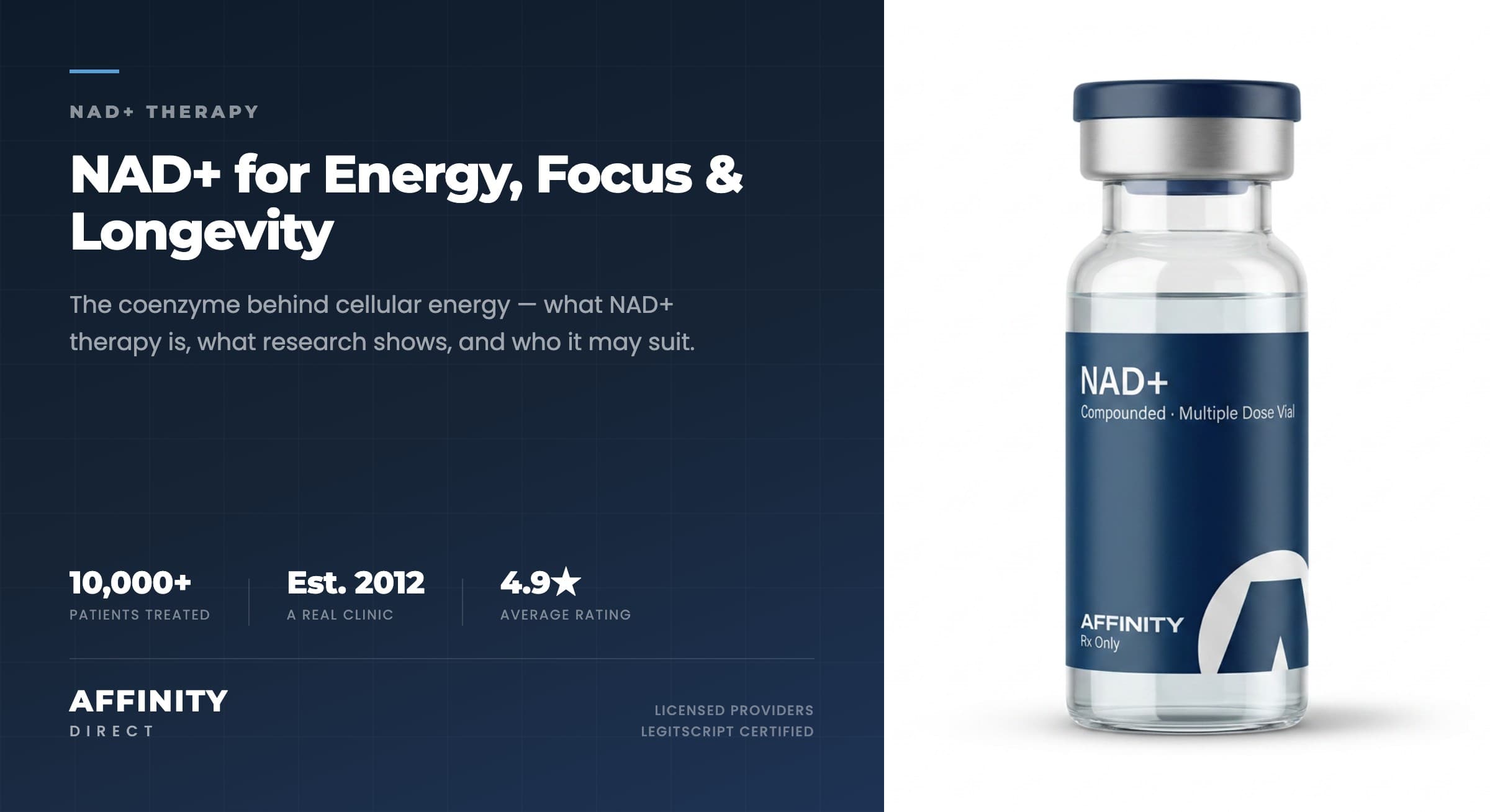
NAD+ has become one of the most talked-about molecules in wellness and longevity circles, and also one of the most over-hyped. The biology is genuinely fascinating: NAD+ sits at the center of how every cell makes energy. But the gap between what the laboratory science shows and what marketing often claims is wide, so this is an education-first guide. Our goal is to explain the chemistry honestly, separate what research currently supports from what it does not yet, and help you decide whether a conversation with a licensed provider makes sense.
This article is for general education and is not medical advice. NAD+ injections offered through Affinity Direct are compounded medications that are not FDA-approved for anti-aging, energy, or longevity uses, and those uses are off-label. Whether NAD+ is appropriate for you is a decision for a licensed provider after reviewing your health history.
What is NAD+?
NAD+ (nicotinamide adenine dinucleotide) is a coenzyme found in every living cell. Chemically it is a dinucleotide, two nucleotides joined at their phosphate groups, one built around adenine and the other around nicotinamide (a form of vitamin B3). Its core job is to ferry electrons during the chemical reactions that keep cells alive.
In practical terms, NAD+ acts as a cofactor for the enzymes that run cellular energy metabolism, including glycolysis, fatty acid oxidation, and the citric acid cycle.1 It accepts and shuttles electrons within the pathways that ultimately help cells synthesize ATP, the molecule cells actually spend as fuel. Researchers note that maintaining a proper NAD+/NADH balance is essential, because an imbalance in that ratio can impair flux through these reactions.1
NAD+ does more than support metabolism. It is also consumed by two important families of enzymes: sirtuins (NAD+-dependent enzymes involved in cellular maintenance and stress responses) and PARPs (involved in DNA repair).1 Both draw on NAD+ as they work, which is part of why cellular demand for it is so high.
NAD+, mitochondria, sirtuins, and DNA repair
Three of NAD+'s roles get the most attention in longevity research:
- Energy metabolism. NAD+ is a required cofactor across the central pathways cells use to extract energy from nutrients, so the NAD+/NADH balance is tightly linked to how efficiently those reactions run.1
- Sirtuins. Sirtuins are NAD+-dependent enzymes that consume NAD+ and help maintain and regulate cellular homeostasis. Their activity is tied directly to how much NAD+ is available.1
- DNA repair. When DNA is damaged, PARP enzymes are activated to coordinate repair, and that heavy PARP activity consumes large amounts of NAD+, which can draw down cellular reserves.1
This is the mechanistic story behind NAD+ enthusiasm: it touches energy, cellular upkeep, and genome maintenance all at once. It is genuinely central biology. What is less settled is whether adding NAD+ from the outside reliably improves any of these processes in healthy adults, which we cover below.
Why NAD+ declines with age
One reason NAD+ is studied so heavily in aging is that levels appear to fall over time. Research indicates that NAMPT (an enzyme that helps make NAD+) and NAD+ levels themselves decline with age across multiple organs, including the pancreas, adipose tissue, skeletal muscle, liver, and brain, and that reduced NAD+ availability is associated with lower sirtuin activity.2
Researchers describe the link between NAD+ and sirtuins as having a role in regulating physiological robustness and as a contributor to aging and longevity control across diverse organisms.2 That has made restoring NAD+ a leading hypothesis in longevity science. A hypothesis, though, is not a proven outcome, and that distinction matters a great deal here.
What the research does, and does not, show
This is where careful reading matters. The strongest evidence for raising NAD+ comes from preclinical (animal) research, not from large human trials.
In model organisms, NAD+ pathways have been associated with longer lifespan. In yeast, worms, and flies, lifespan extension tied to these pathways is sirtuin-dependent, and in mice, brain-specific overexpression of the sirtuin SIRT1 has been associated with delayed aging and lifespan extension in both sexes.2 These are striking findings, but they are in animals.
In humans, the picture is far more modest. Studies of oral NAD+ precursors reliably raise measured NAD+ levels, with one trial in older adults reporting a roughly 139% increase in blood NAD+, yet that biochemical change has not consistently produced the hoped-for health improvements; systematic reviews summarized in that analysis found minimal impact on measures such as muscle index, grip strength, gait speed, and chair-stand performance.3 In a separate double-blind randomized trial, NAD+ supplementation over four weeks did not improve cognition more than placebo.4 As one research summary put it: restoring a molecule is not the same as restoring function.3
The honest bottom line: NAD+'s biology is well established, but the human clinical evidence that supplementing it improves energy, cognition, or longevity is early, mixed, and far from conclusive. Be skeptical of any source that promises a specific result.
Routes of administration
NAD+ and its precursors are delivered in several ways, and they are not interchangeable. We do not provide dosing here, since that is a provider's role, but understanding the formats helps frame the conversation.
| Format | How it is given | What to know |
|---|---|---|
| Oral precursors (NR, NMN) | Capsules or powder; the body converts them toward NAD+ | Most-studied human format; reliably raises NAD+ but reported clinical benefits are modest3 |
| IV NAD+ infusion | Slow drip over hours in a clinic | Frequently associated with GI side effects in small studies; efficacy not established5 |
| Subcutaneous injection | Compounded NAD+ given under the skin | The format Affinity offers; off-label, compounded, requires a prescription |
On the intravenous route specifically, a small pilot pharmacokinetic study found that infused NAD+ is rapidly removed from plasma and broken down enzymatically rather than circulating intact, and the authors noted that the metabolic fate of IV NAD+ had not previously been reported in humans, which underscores how preliminary this area still is.6 A separate small retrospective pilot study reported that participants who received IV NAD+ commonly experienced moderate to severe abdominal cramping, nausea, vomiting, and a faster heart rate during infusion, with metabolic outcomes described as variable; the authors framed it as an early, real-world look that warrants further investigation.5
Who might consider NAD+ therapy
People drawn to NAD+ are typically interested in cellular energy, recovery, focus, and healthy aging as part of a broader wellness routine. Because the human evidence is still developing, NAD+ is best thought of as an optional, provider-guided choice layered on top of the fundamentals, including sleep, nutrition, exercise, and managing stress, rather than a replacement for them.
It is not for everyone. A licensed provider needs to review your medical history, current medications, and goals before deciding whether a compounded NAD+ injection is appropriate. With Affinity Direct, you complete a short online intake, a provider reviews it (usually within 24 hours), and you are charged at checkout with a full refund if a provider does not approve treatment. If approved, your medication is compounded by a licensed U.S. pharmacy and ships free in two days with syringes and alcohol prep pads included. You can read more on the NAD+ therapy page or take the 60-second peptide match quiz to see what might fit your goals.
NAD+ is one of several options we offer. If your main interest is daytime energy and mental clarity, our guide to peptides for energy and focus compares the choices, and if skin and aging are the priority, see peptides for skin and anti-aging. Affinity also offers glutathione, often described as the body's master antioxidant. For the big-picture overview of how prescribed, pharmacy-compounded peptide therapy works, start with our complete peptide therapy guide or browse the full peptide menu.
Common questions
Is NAD+ the same as HGH or a steroid?
No. NAD+ is a naturally occurring coenzyme that every cell uses to carry electrons for energy metabolism and that is consumed by sirtuin and DNA-repair enzymes.1 It is not a hormone, a steroid, or a synthetic growth hormone.
Will NAD+ injections make me feel more energetic right away?
There is no reliable evidence to promise that. While NAD+ is central to the pathways cells use to produce ATP,1 human studies of raising NAD+ have shown modest or absent effects on outcomes like cognition and muscle performance.34 Individual responses may vary, and a provider can help set realistic expectations.
Are NAD+ injections FDA-approved?
The compounded NAD+ injections offered through Affinity Direct are not FDA-approved, and using NAD+ for energy, focus, or anti-aging is off-label. They are prescribed by a licensed provider and prepared by a licensed U.S. compounding pharmacy, which is very different from the unregulated "research chemicals" sold online.
Are there side effects?
Reported side effects depend on the format. In a small study, intravenous NAD+ was commonly associated with abdominal cramping, nausea, vomiting, and a faster heart rate during infusion, especially when infused quickly.5 Any potential risks for you specifically should be reviewed with your provider during your free medical review.
This content is educational and is not medical advice, a diagnosis, or a treatment recommendation. NAD+ is not intended to diagnose, treat, cure, or prevent any disease. Talk with a licensed provider about whether NAD+ therapy is right for you.
This article is for general education and is not medical advice. These statements have not been evaluated by the FDA. These products are not intended to diagnose, treat, cure, or prevent any disease. Compounded medications require a valid prescription from a licensed provider. For investigational/wellness use only. Talk with a licensed Affinity Direct provider about whether peptide therapy is right for you.