If you have started shopping for peptide therapy, you have probably noticed the prices are all over the map — and the fine print is worse. Some clinics quote a low per-vial number and then add a monthly membership; others bury shipping, lab, or "program" fees. This is a plain-spoken look at what peptide therapy actually costs, what should be included in an honest price, and how Affinity Direct prices the five peptides we offer. This article is educational, not medical advice — whether any peptide is appropriate for you is a decision for a licensed provider.
What you actually pay for with peptide therapy
A peptide price is never just the drug in the vial. A complete, compliant peptide program bundles several real costs, and understanding them is the key to comparing two offers fairly:
- The medical review. Peptides are prescription medications. A licensed provider has to review your health intake and decide whether treatment is appropriate before anything ships. At Affinity Direct, that free medical review is built into the price, not billed separately.
- The compounded medication. These peptides are made to order by a licensed U.S. 503A compounding pharmacy. Compounded drugs are prepared for an individual patient and are not FDA-approved — the FDA does not review them for safety, effectiveness, or quality the way it does mass-manufactured drugs.1 A legitimate price reflects pharmacy-grade sourcing and sterile preparation.
- The supplies. Every Affinity order includes the syringes and alcohol prep pads needed for the prescribed regimen, at no extra charge.
- Shipping. Free 2-day discreet shipping is included. Watch for offers that advertise a low vial price and then add expedited or cold-chain shipping at checkout.
When a price includes all four of those, you are comparing apples to apples. When it doesn't, the headline number is misleading.
Affinity Direct peptide pricing
Here is exactly what each peptide starts at and what comes in the box. Every peptide can be bought one-time with no membership fee and no subscription requirement, and you are charged at checkout with a full refund if a provider does not approve treatment. If you would rather it arrive on a schedule, Subscribe & Save takes 15% off every refill and you can cancel any time — it is an option, never a condition of the price.
| Peptide | Starting price | What it's studied for | Included |
|---|---|---|---|
| NAD+ | From $219 10 mL · 1-month supply · $219.00/month | Cellular energy, mitochondrial function, longevity pathways | Medical review, compounded vial, syringes, alcohol prep pads, free 2-day shipping |
| PT-141 (Bremelanotide) | From $219 5 mL · 10–20 doses (as needed) · $10.95–$21.90/dose | Sexual desire (a brain-pathway mechanism, not blood flow) | Medical review, compounded vial, syringes, alcohol prep pads, free 2-day shipping |
| Sermorelin | From $219 5 mL · 1-month supply · $219.00/month | Lean body composition, recovery, sleep quality | Medical review, compounded vial, syringes, alcohol prep pads, free 2-day shipping |
| Glutathione | From $169 10 mL · 1-month supply · $169.00/month | Oxidative-stress balance, skin brightness, detox support | Medical review, compounded vial, syringes, alcohol prep pads, free 2-day shipping |
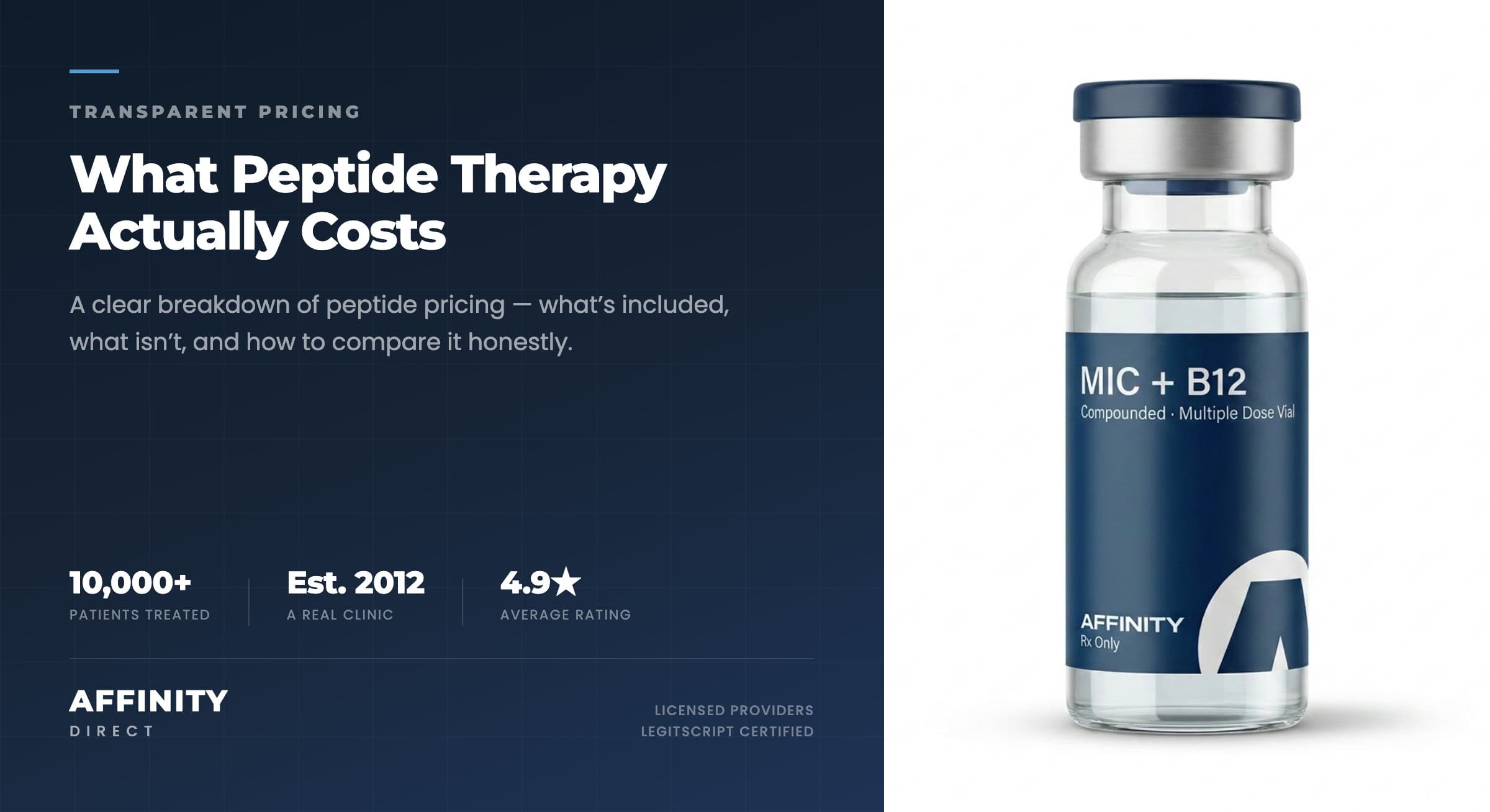
| MIC + B12 | From $349 30 mL · 3-month supply · $116.33/month | Adjunct to a weight-management / nutrition + exercise plan | Medical review, compounded vial, syringes, alcohol prep pads, free 2-day shipping |
Not sure which one fits what you're after? The 60-second match quiz walks you through your goals and points you to the right starting place, or you can browse all five on the peptide hub. For a deeper primer on how these work, see our complete guide to peptide therapy.
Why the prices differ by peptide
The spread isn't arbitrary, but it is easy to read backwards. The sticker price mostly tracks how much medication is in the box, not how expensive the molecule is. Glutathione and MIC + B12 ship as a single 30 mL vial — a 15-week supply — so they carry the highest one-time price and, at $169.00/month, the lowest weekly cost of the five. NAD+ and Sermorelin ship as 10 mL vials, so they cost less up front and more per week. PT-141 is priced per dose rather than per week because it is taken as needed.
Compare the weekly or per-dose column, not the headline. Two offers can look far apart on the sticker and land in the same place once you divide by what is actually in the vial.
MIC + B12 — the lowest weekly cost
MIC + B12 is a lipotropic blend of methionine, inositol, and choline plus vitamin B12. The ingredients are inexpensive and well characterized; it ships as a 30 mL vial, which is why its one-time price ($349) is among the highest here while its weekly cost ($116.33/month) is among the lowest. It is used as an adjunct to a nutrition-and-exercise program rather than a standalone weight-loss drug, and the clinical evidence for meaningful weight loss is limited — research has not confirmed lipotropic injections are effective for that purpose, so it is best thought of as support for habits you're already building, not a shortcut.2
Glutathione — the master antioxidant
Glutathione ships as a single 30 mL vial ($169, a 15-week supply at $169.00/month). It is a tripeptide built from glutamate, cysteine, and glycine, and it is one of the body's most abundant antioxidants — a free-radical scavenger involved in detoxification and redox balance.3 It is associated with oxidative-stress balance and skin brightness in wellness use. Like the others here, its injectable use for these purposes is off-label and compounded.
NAD+ — the longevity coenzyme
NAD+ (nicotinamide adenine dinucleotide) is a coenzyme central to turning food into cellular energy (ATP); it also helps cells repair damaged DNA, and its levels naturally decline with age.4 That biology is why NAD+ shows up in longevity conversations — though many of the bolder claims rest on early research, so it's worth keeping expectations measured. Injectable NAD+ is off-label and compounded.
Sermorelin — signals your own growth hormone
Sermorelin is a growth-hormone-releasing hormone (GHRH) analogue — a 29-amino-acid peptide that stimulates your own pituitary gland to secrete growth hormone, rather than supplying synthetic HGH.5 Its adult wellness and anti-aging use is off-label and compounded; its original FDA approval was as a pediatric diagnostic. Its higher price reflects the peptide's complexity. If recovery and body composition are your focus, our overview of peptides for muscle and recovery goes deeper.
PT-141 — a different mechanism entirely
PT-141 (bremelanotide) is the one product here priced by the dose rather than by the week, because it is taken as needed rather than on a schedule — a 5 mL · 10–20 doses (as needed) pack works out to $10.95–$21.90/dose. It is a melanocortin-receptor agonist that acts in the brain on sexual desire — a different pathway than ED pills, which work on blood flow. As Vyleesi, bremelanotide is FDA-approved specifically for hypoactive sexual desire disorder (HSDD) in premenopausal women;6 use in men or for general libido is off-label, and Affinity offers it compounded.
How to compare peptide offers honestly
Once you know what a complete price includes, the traps are easier to spot. A few things to watch for as you shop:
- Membership and "program" fees. A surprisingly low vial price often hides a recurring monthly charge that makes the real cost far higher. Add the membership to the medication and compare that total. Affinity charges no membership and requires no subscription.
- "Lifetime" lab or consult fees added later. A complete price should already include the provider review. If a consult or "treatment plan" fee appears at checkout, fold it into your comparison.
- Gray-market and "research chemical" pricing. If a peptide is dramatically cheaper than everyone else and labeled "for research use only" or "not for human consumption," that is a red flag — it is not a provider-prescribed, pharmacy-compounded medication. Provider-prescribed, pharmacy-compounded peptides from a real clinic are a different product than unregulated vials sold online. For more on that distinction, read are peptides safe and legal?
- Subscription lock-in. Some programs only publish their best price on an auto-ship you then have to remember to cancel. Every Affinity peptide is available as a one-time purchase at the price shown; Subscribe & Save is a 15% discount you can choose and cancel at any time, not a condition of buying.
The honest comparison is always total cost for what's actually in the box, from a source you can verify. A higher sticker price that includes the review, the medication, the supplies, and shipping — with a refund if you aren't approved — is frequently cheaper than a "budget" offer once the add-ons land.
Is peptide therapy worth the cost?
That depends entirely on your goals and whether a provider thinks treatment is appropriate for you — which is exactly why the review comes first and the refund exists if it's a no. What we can say plainly is that the model is built to remove the usual risk of paying for something you can't use: you are evaluated by a licensed provider (typically within 24 hours), and if treatment isn't approved, you are refunded in full. When you're ready, our walkthrough on how to get peptide therapy online covers exactly what the process looks like step by step.
Common questions
Are there any hidden fees with Affinity peptide therapy?
No. The price you see is the price you pay: it includes the free medical review, the compounded medication, syringes, alcohol prep pads, and free 2-day discreet shipping. There is no membership fee and no separate consult fee, and no subscription is required — Subscribe & Save is an optional 15% discount you can cancel at any time.
Do I pay before I know if I'm approved?
You are charged at checkout, and a licensed provider reviews your intake afterward — usually within 24 hours. If the provider does not approve treatment, you receive a full refund. You never pay for medication you can't get.
Why are compounded peptides priced differently than a name-brand drug?
Compounded medications are prepared for an individual patient by a licensed pharmacy and are not FDA-approved, so they are priced and regulated differently than mass-manufactured, FDA-approved products.1 The price reflects pharmacy-grade compounding, not a retail markup on an off-the-shelf drug. A provider can explain whether a compounded option is appropriate for your situation.
Is the cheapest peptide always the best deal?
Not necessarily. The lowest sticker price often excludes the provider review, supplies, or shipping — or comes with a membership that raises the true cost. Compare the all-in total from a verifiable, provider-prescribed source rather than the headline number, and be cautious of unusually cheap "research" peptides that aren't pharmacy-compounded.
This article is for general education and is not medical advice. These statements have not been evaluated by the FDA. These products are not intended to diagnose, treat, cure, or prevent any disease. Compounded medications require a valid prescription from a licensed provider. For investigational/wellness use only. Talk with a licensed Affinity Direct provider about whether peptide therapy is right for you.