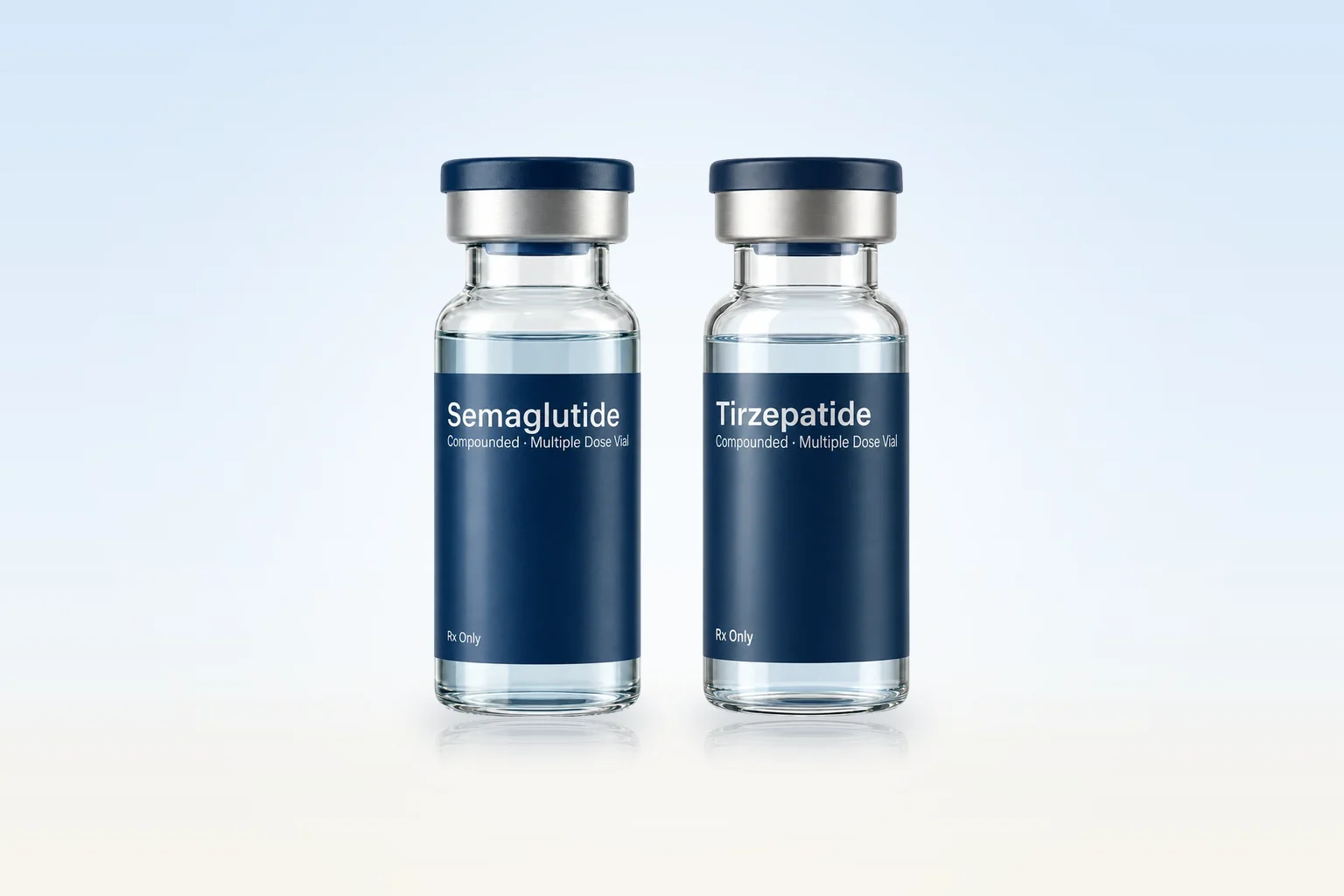
If you're researching semaglutide vs. tirzepatide, you've probably encountered two popular names in medical weight management.
Both medications have attracted attention because clinical studies have demonstrated significant weight reduction in many participants when treatment is combined with nutrition and physical activity changes.
Both can help regulate appetite, increase feelings of fullness, and make it easier for some people to maintain a reduced-calorie eating pattern.
And both have become important options in conversations about long-term weight management.
But semaglutide and tirzepatide are not identical.
They activate different combinations of hormone receptors, have different clinical trial results, and may suit different treatment preferences.
If you're trying to decide between them, the most useful question isn't simply which medication produces the biggest number on a weight-loss chart.
It's which option is medically appropriate, financially sustainable, and realistic for your long-term health goals.
At Affinity Direct, patients can explore both compounded semaglutide and compounded tirzepatide, subject to provider assessment and applicable compounding requirements.
This guide compares their mechanisms, clinical evidence, treatment schedules, side effects, pricing, and practical considerations so you can have a more informed conversation with a licensed healthcare provider.
An important distinction: The major clinical trials discussed below studied specific FDA-approved semaglutide and tirzepatide products. Compounded preparations are separate, non-FDA-approved medications. Their safety, effectiveness, quality, and equivalence to approved products have not been established through FDA review.
Semaglutide vs. Tirzepatide: Quick Comparison
Both medications act on hormone pathways involved in appetite and metabolic regulation.
The biggest difference is that semaglutide targets one incretin receptor, while tirzepatide targets two.
Feature | Semaglutide | Tirzepatide |
Medication class | GLP-1 receptor agonist | Dual GIP and GLP-1 receptor agonist |
Main action | Supports fullness and appetite regulation | Activates two incretin pathways involved in appetite and metabolism |
FDA-approved weight-management brand | Wegovy | Zepbound |
Other well-known brand | Ozempic, approved for certain diabetes-related indications | Mounjaro, approved for type 2 diabetes |
Injectable dosing | Once weekly | Once weekly |
Starting injectable dose in approved weight-management regimens | 0.25 mg weekly | 2.5 mg weekly |
Head-to-head average weight reduction at 72 weeks | 13.7% | 20.2% |
Common side effects | Primarily gastrointestinal | Primarily gastrointestinal |
Affinity Direct compounded starting price | From $96.05/month* | From $120.14/month* |
Affinity Direct prices are based on the qualifying three-month auto-refill plans described on its weight-loss page. Prices, availability, and plan terms may change. The head-to-head trial results refer to FDA-approved products, not Affinity Direct's compounded formulations.
Both medications deserve serious consideration where clinically appropriate.
Semaglutide has an extensive evidence base, meaningful weight-loss outcomes, and a lower advertised starting price through Affinity Direct.
Tirzepatide offers a dual-receptor mechanism and demonstrated greater average weight loss in the head-to-head trial.
Neither medication guarantees a particular result.
What Is the Difference Between Semaglutide and Tirzepatide?
The primary difference between semaglutide and tirzepatide is how they interact with the body's incretin hormone system.
Incretins are hormones involved in regulating blood sugar, digestion, appetite, and responses to food.
Two important incretin pathways involve glucagon-like peptide-1, or GLP-1, and glucose-dependent insulinotropic polypeptide, or GIP.
Semaglutide acts on the GLP-1 receptor.
Tirzepatide acts on both the GLP-1 and GIP receptors.
Although both medications influence appetite and metabolic processes, the additional GIP activity makes tirzepatide pharmacologically distinct.
How semaglutide works
Semaglutide is a GLP-1 receptor agonist.
It mimics certain actions of the naturally occurring GLP-1 hormone, which is released in response to eating.
Activating GLP-1 receptors can influence appetite regulation in the brain, increase feelings of fullness, slow gastric emptying, and support glucose-dependent insulin secretion.
For weight management, the effects on appetite and food intake are especially important.
Many patients describe feeling satisfied with smaller portions or experiencing less frequent hunger while taking GLP-1 medication.
These changes may make it easier to maintain a reduced-calorie diet.
However, medication does not replace balanced nutrition, physical activity, adequate protein, or other healthy routines.
Semaglutide's clinical evidence has helped establish GLP-1 receptor agonists as an important part of modern obesity treatment.
For a deeper explanation of this mechanism, Affinity Direct also publishes “GLP-1 Medications for Weight Loss: How Semaglutide Works.”
How tirzepatide works
Tirzepatide is a dual GIP and GLP-1 receptor agonist.
Like semaglutide, it activates GLP-1 receptors.
It also activates GIP receptors, which participate in metabolic regulation and nutrient-related signaling.
This dual action distinguishes tirzepatide from medications that target GLP-1 alone.
Clinical trials of FDA-approved tirzepatide have demonstrated substantial average weight reduction.
Researchers continue to investigate the relative contributions of GIP and GLP-1 signaling to tirzepatide's overall effects.
It would be too simplistic to say that activating two receptors automatically makes a medication better for every patient.
The evidence supports greater average weight loss with tirzepatide in a particular head-to-head trial, but individual treatment decisions still require a broader assessment.
Is Tirzepatide Better Than Semaglutide for Weight Loss?
Tirzepatide produced greater average weight reduction than semaglutide in a major direct-comparison clinical trial.
That is an important finding.
But it does not mean tirzepatide is automatically the better treatment for every individual.
A medication's value depends on more than average efficacy.
Tolerability, medical conditions, treatment cost, access, and the ability to continue therapy all matter.
Someone who responds well to semaglutide and tolerates it comfortably may have good reasons to continue that treatment.
Another person may discuss tirzepatide with their provider because its clinical evidence and treatment profile better align with their needs.
What the SURMOUNT-5 trial found
SURMOUNT-5 directly compared FDA-approved tirzepatide and semaglutide in adults with obesity, or overweight with a weight-related condition, who did not have diabetes.
The study included 751 randomized participants.
At 72 weeks, average weight reduction was:
20.2% with tirzepatide
13.7% with semaglutide
The difference was statistically significant.
Participants receiving tirzepatide also experienced greater average reductions in waist circumference.
Both groups achieved clinically meaningful weight reduction.
These results provide stronger comparative evidence than simply looking at separate trials with different populations and methods.
However, SURMOUNT-5 does not establish that every person will lose more weight with tirzepatide.
It also does not demonstrate that compounded versions of either medication will reproduce the same outcomes.
What do those percentages mean in pounds?
Consider a hypothetical person starting at 230 pounds.
Applying the SURMOUNT-5 group averages mathematically gives:
Treatment group | Average percentage | Illustrative weight change |
Semaglutide | 13.7% | About 31.5 pounds |
Tirzepatide | 20.2% | About 46.5 pounds |
These figures are illustrations of trial averages, not individual predictions.
Actual results can be higher or lower.
Participants received specific FDA-approved products and structured treatment within a clinical study. Results should not be used as a forecast for compounded medication.
The useful takeaway is that both medications demonstrated substantial average weight loss, with tirzepatide achieving a greater average reduction in that study.
Semaglutide Weight-Loss Results: What Clinical Trials Show
Semaglutide has been studied extensively for chronic weight management.
One of its landmark studies is STEP 1.
In that trial, adults with overweight or obesity, without diabetes, received once-weekly semaglutide 2.4 mg or placebo alongside lifestyle intervention.
Over 68 weeks, participants assigned to semaglutide experienced approximately 14.9% average body-weight reduction.
That result helped demonstrate that GLP-1 receptor agonist treatment could produce meaningful weight changes beyond those typically seen with lifestyle intervention alone.
Why semaglutide remains an important option
Semaglutide offers several meaningful strengths.
First, it has an extensive clinical research history.
Second, the approved injectable weight-management regimen uses once-weekly administration, which many patients find convenient.
Third, its effects on appetite and fullness may help patients follow nutrition plans more consistently.
Finally, treatment decisions are not determined by maximum average weight loss alone.
For some people, cost, prior treatment response, medication tolerance, or clinical considerations may make semaglutide a reasonable option.
The availability of another medication with higher average weight loss does not eliminate semaglutide's established clinical value.
Does semaglutide work for everyone?
No medication works equally well for every patient.
Some people experience substantial weight reduction.
Others experience more modest changes.
Factors such as dose, treatment duration, adherence, individual biology, and lifestyle habits can influence outcomes.
A healthcare provider can assess progress over time and determine whether the treatment plan should be adjusted.
Patients should not increase doses independently in an attempt to match someone else's results.
Tirzepatide Weight-Loss Results: What Clinical Trials Show
Tirzepatide has also demonstrated substantial weight-loss outcomes in large clinical studies.
One landmark study is SURMOUNT-1.
In adults with obesity, or overweight with a weight-related complication, without diabetes, tirzepatide produced dose-dependent average weight reduction over 72 weeks.
At the highest studied dose, average weight loss approached 21% of starting body weight.
These findings helped establish tirzepatide as an important advancement in medical weight management.
Why tirzepatide attracts interest
Its dual GIP and GLP-1 receptor activity is a distinguishing feature.
The clinical trial results also show that substantial weight reduction is possible for many participants receiving the approved treatment.
For patients and clinicians comparing treatment options, these findings are relevant.
However, greater average efficacy does not remove the need for careful dose escalation, side-effect management, and ongoing medical supervision.
Does tirzepatide guarantee faster or greater results?
No.
Clinical trial averages describe outcomes across groups of participants.
They cannot predict an individual patient's response.
Someone taking semaglutide may experience greater weight loss than another person taking tirzepatide.
The comparison is about average outcomes under studied conditions, not a guarantee for any specific person.
Semaglutide vs. Tirzepatide for Appetite Control
Both medications can influence appetite, fullness, and food intake.
These effects are among the reasons they can support weight management.
Patients may notice changes such as becoming satisfied with smaller meals, thinking about food less frequently, or finding it easier to stop eating when full.
However, appetite responses differ.
Some people experience noticeable changes early in treatment.
Others notice more gradual effects as their provider adjusts the dose.
Does tirzepatide suppress appetite more than semaglutide?
Tirzepatide's greater average weight reduction in clinical trials suggests differences in overall treatment effects.
However, it is not accurate to promise that every patient will experience stronger appetite suppression with tirzepatide.
Appetite is influenced by sleep, stress, meal composition, medications, hormones, and individual physiology.
The better question is whether a particular treatment helps a patient manage hunger and maintain appropriate nutrition without unacceptable side effects.
Can semaglutide help reduce food cravings?
Some patients report changes in hunger, food preferences, and cravings while receiving GLP-1 treatment.
These experiences are not identical across individuals.
A reduction in appetite should not be interpreted as a reason to skip essential nutrition.
Adequate protein, fluids, and nutrient-dense foods remain important.
Can tirzepatide help with portion control?
Tirzepatide may help some patients feel full with smaller portions.
That can support a structured eating plan.
However, eating too little or becoming dehydrated can create additional problems.
Patients should discuss persistent inability to eat, vomiting, or other concerning symptoms with their care team.
How Long Does Semaglutide or Tirzepatide Take to Work?
Both medications begin acting on relevant biological pathways after administration, but visible weight reduction develops over time.
Treatment typically begins at a low dose.
The dose is then increased gradually according to the approved regimen and clinical assessment.
This process is called titration.
The first few weeks
During early treatment, some patients notice changes in appetite or fullness.
Others notice little difference at first.
The starting doses are designed primarily to help the body adjust to treatment rather than produce the maximum weight-loss effect.
It is important not to judge long-term success solely by the first injection or first week.
The first three months
As treatment progresses, some patients begin seeing more noticeable changes in weight and eating patterns.
However, the amount and timing vary considerably.
Providers may evaluate tolerability, hydration, nutritional intake, and overall progress before deciding whether to increase the dose.
Six months and beyond
Weight management is a longer-term process.
Clinical trials commonly assess results over many months, not just a few weeks.
Patients may continue losing weight over time, although the rate often changes.
A plateau does not necessarily mean a medication has stopped working.
For a broader discussion of early treatment expectations, read Affinity Direct's existing article “What Should New Patients Expect in Their First 90 Days on GLP-1 Medications for Weight Loss?”
Semaglutide vs. Tirzepatide Dosing: What's Different?
Both approved injectable weight-management regimens use once-weekly administration.
However, their doses are measured differently and are not interchangeable.
Semaglutide injectable dosing
The established FDA-approved Wegovy injection titration schedule begins at 0.25 mg once weekly.
The dose is generally increased gradually through subsequent steps, depending on tolerability and the prescribed regimen.
Common steps include 0.5 mg, 1 mg, 1.7 mg, and 2.4 mg weekly.
The provider determines the appropriate treatment schedule.
Tirzepatide injectable dosing
The established FDA-approved Zepbound regimen begins at 2.5 mg once weekly.
Dose escalation may proceed through 5 mg, 7.5 mg, 10 mg, 12.5 mg, and 15 mg, depending on the approved schedule and clinical response.
The 2.5 mg starting dose is intended for treatment initiation rather than maintenance.
Are the doses equivalent?
No.
Five milligrams of tirzepatide is not equivalent to five milligrams of semaglutide.
The medications have different structures, pharmacology, and dosing regimens.
Patients should never convert between them using a simple milligram ratio.
This is particularly important with compounded vials, where concentration and syringe-unit instructions may differ.
Any medication change requires individualized prescribing and clear administration instructions.
Semaglutide vs. Tirzepatide Side Effects
Both medications can cause side effects, particularly involving the gastrointestinal system.
Commonly reported effects with FDA-approved products include nausea, diarrhea, vomiting, constipation, and abdominal discomfort.
Symptoms may be more noticeable during dose escalation.
Many gastrointestinal effects are mild to moderate, but some patients experience symptoms that require clinical attention.
Semaglutide side effects
Commonly reported effects include nausea, vomiting, diarrhea, constipation, abdominal pain, and indigestion.
Not every patient experiences these effects.
Some people tolerate semaglutide well, while others need additional support or a change in treatment.
Tirzepatide side effects
Tirzepatide has a broadly similar gastrointestinal side-effect profile.
Reported effects include nausea, diarrhea, vomiting, constipation, abdominal discomfort, and indigestion.
The frequency of specific symptoms depends on the population, dose, and study.
It is difficult to make a universal claim that one medication is always easier to tolerate.
Which is safer: semaglutide or tirzepatide?
Both approved medications have been evaluated in large clinical development programs.
Neither is risk-free.
Important warnings and precautions include gastrointestinal reactions, dehydration-related kidney injury, gallbladder problems, pancreatitis, serious allergic reactions, and other medication-specific concerns.
Both approved injectable weight-management products carry boxed warnings about thyroid C-cell tumors observed in rodents. Their relevance to humans remains uncertain.
They are contraindicated in patients with a personal or family history of medullary thyroid carcinoma or multiple endocrine neoplasia syndrome type 2.
Treatment during pregnancy is not appropriate for weight management.
Tirzepatide can also affect the reliability of oral hormonal contraceptives during initiation and dose escalation; patients should follow product-specific contraceptive guidance.
A healthcare provider should review relevant risks, current medications, and medical history before prescribing.
When should you contact a provider?
Persistent vomiting, inability to maintain hydration, severe abdominal pain, or signs of an allergic reaction require prompt medical attention.
Severe symptoms should not be managed by independently increasing, reducing, or combining medications.
Patients should follow the instructions of their prescribing clinician.
Can You Switch From Semaglutide to Tirzepatide?
Some patients discuss switching medications when their weight-management goals, treatment response, tolerability, or circumstances change.
A switch may be considered after clinical review.
However, there is no universal conversion formula.
Semaglutide and tirzepatide should not be treated as interchangeable products.
A provider must consider the previous medication and dose, time since the last injection, gastrointestinal tolerability, other health conditions, and the proposed new treatment schedule.
Can you take both medications together?
Patients should not combine semaglutide and tirzepatide.
Both act on the GLP-1 pathway, and using them together is not an established weight-management regimen.
Combining them may increase adverse effects without proven additional benefit.
What if your current medication is working?
A treatment does not necessarily need to be changed simply because another medication has a higher average trial result.
If a patient is progressing toward an appropriate goal, tolerating treatment, and maintaining healthy routines, continuing the existing plan may be reasonable.
Any decision to switch should be based on individual clinical circumstances.
Semaglutide vs. Tirzepatide Cost at Affinity Direct
Cost can influence whether a treatment plan is sustainable.
Long-term weight management may involve ongoing medication, follow-up care, and adjustments over time.
Affinity Direct lists both compounded semaglutide and compounded tirzepatide with dose-based pricing.
According to its published weight-loss page:
Pricing detail | Compounded semaglutide | Compounded tirzepatide |
Advertised starting monthly equivalent | $96.05 | $120.14 |
Three-month starter plan | $288.15 per shipment | $360.40 per shipment |
Lowest listed one-month supply | $169 | $174 |
Membership fee | None advertised | None advertised |
Provider review and injection supplies | Included | Included |
Cold shipping | Included | Included |
These are advertised plan prices, not a guarantee that every patient qualifies for a particular dose, formulation, or supply arrangement.
The starting monthly equivalents depend on the specified three-month plans with auto-refill.
Higher doses may cost more.
Patients should review the complete price, refill terms, and treatment availability before checkout.
Why semaglutide may appeal to budget-conscious patients
At Affinity Direct's listed starting prices, compounded semaglutide has the lower advertised monthly cost.
For someone comparing treatment expenses, that difference may be meaningful.
However, price alone does not determine whether treatment is medically appropriate.
Why patients may consider tirzepatide despite a higher price
Some patients may place greater value on tirzepatide's dual-action mechanism and the stronger average weight-loss results demonstrated in approved-product trials.
Others may find the additional expense difficult to sustain.
A good decision balances clinical suitability, treatment goals, and realistic long-term affordability.
Explore current weight-loss plans and pricing at Affinity Direct.
FDA-Approved vs. Compounded Semaglutide and Tirzepatide
This distinction is essential when comparing treatment options.
FDA-approved medications undergo regulatory review of evidence concerning safety, effectiveness, quality, and manufacturing.
For chronic weight management, Wegovy is an FDA-approved semaglutide product and Zepbound is an FDA-approved tirzepatide product.
Affinity Direct's page describes its offerings as compounded semaglutide and compounded tirzepatide prepared by licensed U.S. compounding pharmacies.
Compounded medications are not FDA-approved.
The FDA does not evaluate each compounded preparation for safety, effectiveness, or quality before it is dispensed.
Are compounded versions the same as the branded medications?
No.
A compounded medication is a separate preparation.
Even when it contains an active ingredient associated with an approved medication, it should not be described as FDA-approved or automatically equivalent to the branded product.
The major weight-loss trials discussed in this article did not evaluate Affinity Direct's specific compounded formulations.
Are compounded GLP-1 medications always legally available?
No.
Federal law places restrictions on compounding medications that are essentially copies of commercially available FDA-approved drugs.
The FDA has announced that the semaglutide and tirzepatide injection shortages were resolved and has ended the related broad enforcement-discretion periods.
Patient-specific circumstances may matter under applicable compounding rules, but routine availability should not be assumed.
A licensed clinician's prescription alone does not automatically establish that a compounded copy is permissible.
Any compounded treatment offered must meet applicable federal and state requirements.
Why this matters for patients
Patients should understand exactly what medication they are receiving, who prepares it, how it should be stored and administered, and whether the formulation is legally and clinically appropriate.
They should also receive clear dosing instructions, particularly when medication is supplied in a multidose vial.
The appropriate treatment decision should be based on reliable information rather than assuming that every formulation has the same evidence base.
Which Is Better: Semaglutide or Tirzepatide?
The answer depends on what matters most for the individual patient.
Both active ingredients have demonstrated meaningful weight-management effects in trials of approved products.
Tirzepatide produced greater average weight reduction in a direct comparison.
Semaglutide also has a substantial evidence base and remains an important treatment option.
When semaglutide may be worth discussing
Semaglutide may be a reasonable topic to discuss with a provider when a patient values its established GLP-1 evidence, has responded well to semaglutide previously, or needs to consider the overall cost of treatment.
At Affinity Direct, the advertised compounded semaglutide starting price is lower than the advertised compounded tirzepatide starting price.
That may influence affordability.
However, lower cost does not establish medical suitability, and access to compounded preparations remains subject to applicable requirements.
When tirzepatide may be worth discussing
Tirzepatide may be of particular interest to patients who want to understand the dual GIP/GLP-1 mechanism and the greater average weight reduction observed in SURMOUNT-5.
A provider can explain whether the evidence is relevant to a patient's medical circumstances.
The decision should also account for tolerability, cost, contraindications, and available approved treatment options.
Why individualization matters more than declaring a winner
Two people can have different experiences with the same medication.
One may respond well to semaglutide.
Another may benefit from a different treatment approach.
The most appropriate plan is one that addresses medical needs, can be followed safely, and supports sustainable health improvements.
That is why the comparison should be a starting point for a clinical conversation rather than a substitute for one.
How to Support Weight Loss With Either Medication
Medication is one component of a broader weight-management strategy.
Both semaglutide and tirzepatide have been studied alongside lifestyle interventions.
Healthy routines remain important throughout treatment.
Prioritize adequate protein
When weight decreases, some lean tissue may be lost alongside fat.
Adequate dietary protein and appropriate resistance exercise can help support muscle maintenance.
Protein needs vary by age, body size, kidney health, activity level, and other factors.
A registered dietitian or healthcare provider can help establish an appropriate target.
Include regular physical activity
Physical activity supports cardiovascular fitness, mobility, and overall health.
Walking, cycling, swimming, and other aerobic activities may be appropriate.
Resistance training can help preserve strength and muscle function.
Patients should select activities suited to their health and fitness level.
Stay hydrated
Nausea, vomiting, or reduced food intake may contribute to dehydration.
Regular fluid intake is important, particularly when gastrointestinal side effects occur.
Patients who cannot keep fluids down should contact their care team.
Eat balanced meals
Smaller portions do not eliminate the need for adequate nutrition.
Meals should provide appropriate amounts of protein, fiber, healthy fats, vitamins, and minerals.
A patient who experiences substantial appetite reduction may need guidance to avoid consistently inadequate intake.
Maintain realistic expectations
Weight loss rarely follows a perfectly straight line.
Changes in water balance, bowel habits, physical activity, and other factors can affect the scale.
A short plateau does not necessarily indicate treatment failure.
Affinity Direct's existing article “GLP-1s Work Best When You Do: How to Maximize Results With the Right Habits” explores the role of supportive daily routines.
How Affinity Direct Approaches Weight-Loss Treatment
Affinity Direct is the online arm of Affinity Whole Health, a clinic network operating since 2012.
The service offers an online assessment and licensed-provider review for patients exploring medical weight-management options.
Its published weight-loss page lists compounded semaglutide and compounded tirzepatide, subject to clinical appropriateness and applicable availability requirements.
Step 1: Review available options
Patients can explore the medications, pricing structures, and treatment information available on the Affinity Direct weight-loss page.
Both medications are presented as potential options rather than assuming that one is appropriate for everyone.
Step 2: Complete a health assessment
Patients provide relevant information about medical history, current medications, and treatment goals.
This information helps a licensed provider assess potential risks and determine whether treatment may be suitable.
Step 3: Receive provider review
A licensed clinician reviews the assessment.
Affinity Direct states that reviews typically take 24–48 hours.
The provider may approve treatment when clinically and legally appropriate, request more information, or decline treatment.
Approval is not automatic.
Step 4: Receive treatment instructions if prescribed
When a prescription is appropriate and can lawfully be dispensed, patients receive medication-specific instructions.
These should cover the prescribed dose, injection technique, storage, administration schedule, and potential adverse effects.
Affinity Direct states that injection supplies and cold shipping are included with its listed plans.
Step 5: Continue with follow-up care
Weight management often requires ongoing evaluation.
A provider may review progress, side effects, nutritional concerns, and treatment goals.
Dose adjustments should be made according to clinical judgment, not simply because a higher dose is available.
Affinity Direct also advertises a full refund if its provider does not approve treatment.
Patients should review the current terms before ordering.
Frequently Asked Questions: Semaglutide vs. Tirzepatide
1. What is the main difference between semaglutide and tirzepatide?
Semaglutide activates the GLP-1 receptor. Tirzepatide activates both GIP and GLP-1 receptors. Both affect appetite and metabolic regulation, but they are distinct medications.
2. Is tirzepatide better than semaglutide?
Tirzepatide produced greater average weight loss in the SURMOUNT-5 head-to-head trial. However, the better treatment for an individual depends on clinical suitability, tolerability, cost, and other factors.
3. Which medication produces more weight loss?
In SURMOUNT-5, approved tirzepatide produced 20.2% average weight reduction compared with 13.7% for approved semaglutide at 72 weeks. These averages do not predict individual results or establish outcomes for compounded formulations.
4. Is semaglutide still effective for weight management?
Yes. Clinical trials of FDA-approved semaglutide have demonstrated meaningful average weight reduction, including approximately 14.9% in STEP 1 over 68 weeks.
5. Are semaglutide and tirzepatide the same medication?
No. They are different molecules with different receptor activity and dosing regimens.
6. Are Ozempic and semaglutide the same thing?
Ozempic is an FDA-approved brand containing semaglutide, but the brand, formulation, indication, and dosing matter. For more context, see Affinity Direct's article “Semaglutide vs Ozempic: Are They the Same Drug?”
7. Is Mounjaro the same as tirzepatide?
Mounjaro is an FDA-approved brand containing tirzepatide for type 2 diabetes. Zepbound also contains tirzepatide and has weight-management indications.
8. Which has fewer side effects?
Both medications commonly cause gastrointestinal side effects. Individual tolerability varies, so neither can be declared universally easier to tolerate.
9. Does tirzepatide work faster than semaglutide?
The head-to-head trial demonstrated greater average weight loss at 72 weeks with tirzepatide, but that does not establish that every individual will notice effects sooner.
10. Can I switch from semaglutide to tirzepatide?
A provider may consider switching in appropriate circumstances. The medications are not dose-equivalent, and patients should not make the change independently.
11. Can I take semaglutide and tirzepatide together?
They should not be combined for weight management. Concurrent use is not an established treatment regimen and may increase adverse effects.
12. Is semaglutide cheaper than tirzepatide?
At Affinity Direct's published starting prices, compounded semaglutide has a lower advertised monthly equivalent. Actual costs depend on dose and plan terms.
13. Do both medications require injections?
The FDA-approved injectable weight-management regimens discussed here are once weekly. Other approved semaglutide formulations exist, but they should not be assumed interchangeable with injectable regimens.
14. Are compounded semaglutide and tirzepatide FDA-approved?
No. Compounded preparations are not FDA-approved and have not undergone the same FDA review as approved products.
15. Do compounded versions produce the same results as branded medications?
That has not been established. Trial results for FDA-approved products should not be represented as proven results for compounded preparations.
16. Which medication is better for appetite control?
Both can affect appetite and fullness. Tirzepatide demonstrated greater average weight loss in a head-to-head study, but individual appetite responses vary.
17. How long do I need to take weight-loss medication?
Duration depends on the medication, clinical response, health conditions, and treatment plan. Obesity is often managed as a chronic condition, and discontinuing treatment can lead to weight regain.
18. What happens if I stop treatment?
Weight regain can occur after stopping either medication. Patients should discuss long-term maintenance strategies with their provider rather than discontinuing treatment without a plan.
19. Which medication is best for someone starting weight-loss treatment?
There is no universal answer. A clinician should consider medical eligibility, contraindications, preferences, cost, and access to appropriate products.
20. Does Affinity Direct offer both semaglutide and tirzepatide?
Affinity Direct's published weight-loss page lists both compounded semaglutide and compounded tirzepatide. Actual prescribing and dispensing depend on medical assessment, current availability, and applicable legal requirements.
Final Thoughts: Semaglutide and Tirzepatide Both Have a Place in Weight Management
The semaglutide vs. tirzepatide comparison is not simply a question of which medication produces the highest average weight-loss percentage.
Both active ingredients have substantial clinical evidence supporting their use in approved weight-management treatments.
Semaglutide offers an established GLP-1 mechanism, extensive research, and meaningful average results.
Tirzepatide offers dual GIP and GLP-1 receptor activity and demonstrated greater average weight reduction in a major head-to-head trial.
Those differences are important, but so are medical suitability, side effects, affordability, and long-term sustainability.
The most appropriate treatment is not necessarily the one with the largest trial result. It is the one that fits a patient's health needs and can be used safely as part of a sustainable care plan.
Affinity Direct provides information about both compounded semaglutide and compounded tirzepatide, with licensed-provider review and transparent advertised pricing. Compounded treatment is not FDA-approved and may only be prescribed and dispensed when clinically appropriate and legally permissible.
If you're considering medical weight management, start by learning about the available options and discussing your goals with a qualified healthcare professional.
Explore Weight-Loss Treatment Options at Affinity Direct
Medical disclaimer: This article is educational and does not constitute personalized medical advice. Prescription weight-management medications require clinical assessment and are not appropriate for everyone. FDA-approved product trial results cannot be assumed to apply to compounded preparations. Treatment availability, prescribing, and dispensing must comply with applicable laws and medical standards.