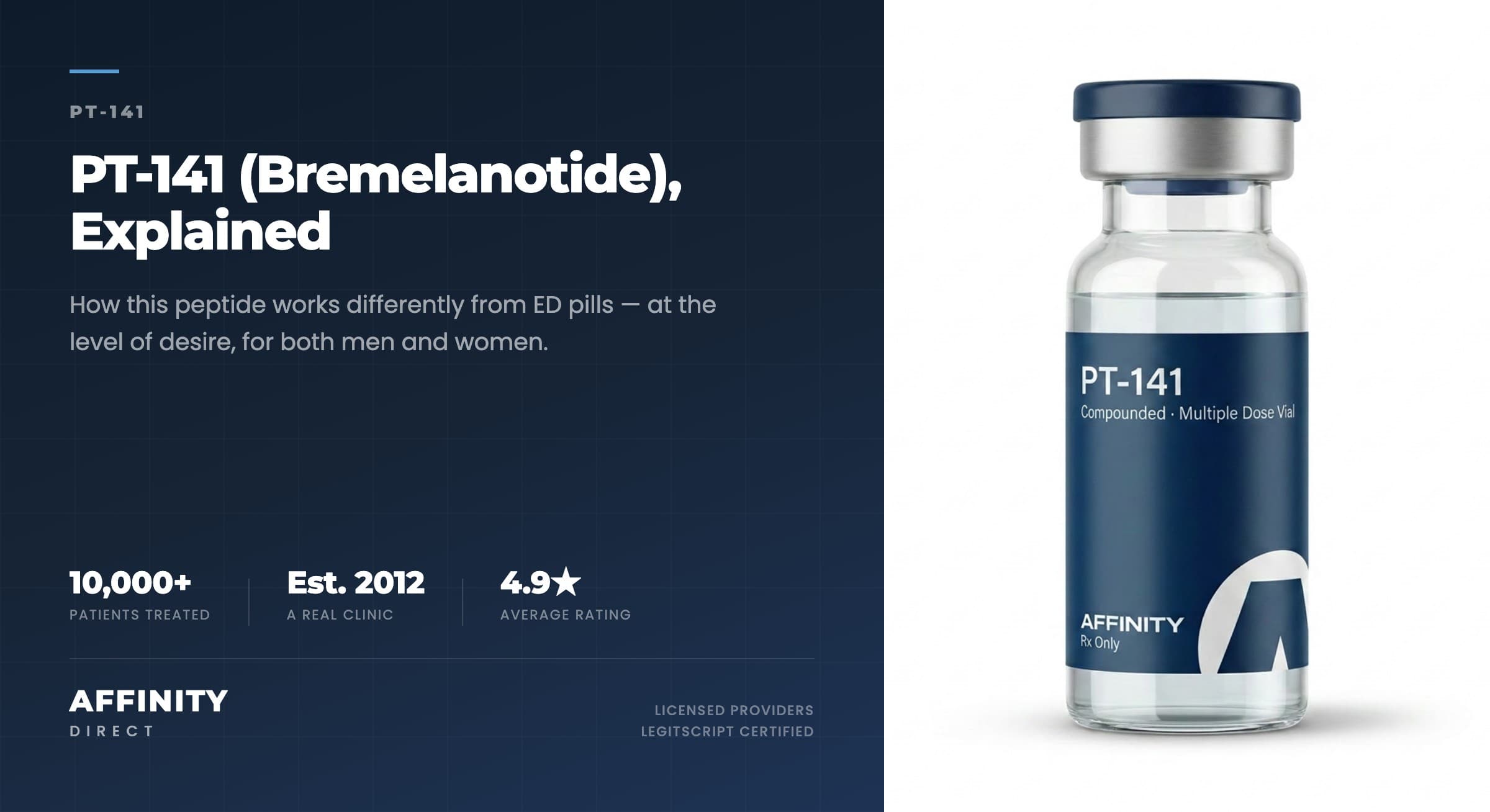
Most treatments aimed at the bedroom work on one thing: blood flow. PT-141 (bremelanotide) is different. Instead of acting on blood vessels, it is thought to work in the brain on the signal that comes before physical arousal — sexual desire itself. That distinction is the whole reason people ask about it, and the source of most of the confusion. This guide is educational, not medical advice: it explains what bremelanotide is, what the research shows, exactly where it is FDA-approved and where it is not, and how a real clinic thinks about it. A licensed provider should always evaluate whether any peptide is appropriate for you.
What PT-141 (bremelanotide) is
PT-141 is the research name for bremelanotide, a synthetic peptide analogue of a natural hormone called alpha-melanocyte-stimulating hormone (α-MSH). It belongs to a class called melanocortin receptor agonists — molecules that engage the body's melanocortin signaling system, predominantly the MC1 and MC4 receptors.2 It is given as a small subcutaneous (under-the-skin) injection rather than a pill.
It is important to be clear about what this is — and is not. Provider-prescribed, pharmacy-compounded bremelanotide is a regulated medication dispensed by a licensed U.S. pharmacy after a clinician reviews your health history. That is categorically different from the unregulated "research chemical" PT-141 sold online with a "not for human consumption" label and no oversight. Affinity Direct is a real Midwest clinic, established in 2012, and offers compounded PT-141 only after a licensed provider review. The compounded formulation is not an FDA-approved product, and for most people who ask about it the use is off-label — more on that below.
How it works: desire in the brain, not blood flow
This is the single most useful thing to understand about PT-141, so it is worth getting right. Bremelanotide is thought to act centrally — in the brain. One review describes it acting on the MC4 receptor to stimulate dopamine release in areas including the medial preoptic area and the nucleus accumbens — circuitry associated with sexual motivation.4 Importantly, the FDA labeling is candid that the exact mechanism is not settled: it states the mechanism by which the drug improves HSDD is unknown, while noting it works as a melanocortin receptor agonist.3
Contrast that with the familiar ED medications. Sildenafil and tadalafil are PDE5 inhibitors — they work in the body (peripherally) to relax blood vessels and improve blood flow to the penis. They are not aimed at desire; they help a man who wants sex turn that into a physical erection. PT-141 is studied one step upstream, on wanting. Because the two mechanisms address different problems, they are not interchangeable.
| Feature | PT-141 (bremelanotide) | ED pills (sildenafil / tadalafil) |
|---|---|---|
| Where it acts | Brain (central nervous system) | Blood vessels (peripheral) |
| What it targets | Sexual desire / arousal signal | Blood flow for an erection |
| Drug class | Melanocortin receptor agonist | PDE5 inhibitor |
| Form | Subcutaneous injection | Oral tablet |
| FDA-approved use | HSDD in premenopausal women (as Vyleesi) | Erectile dysfunction (and more) |
FDA status: precise, because it matters
Bremelanotide is FDA-approved — but for a narrow, specific use. On June 21, 2019, the FDA approved it under the brand name Vyleesi for premenopausal women with acquired, generalized hypoactive sexual desire disorder (HSDD), and it was the first FDA-approved as-needed treatment for that condition.1 HSDD, in plain terms, is persistently low sexual desire that causes the person genuine distress and is not better explained by another medical condition, a relationship problem, or a medication.
Everything outside that exact box is off-label. That includes use in men, use in postmenopausal women, and use for general "low libido" that does not meet the HSDD definition. Off-label prescribing is legal and common when a licensed provider judges it appropriate, but it should be a deliberate clinical decision — not a marketing claim. The compounded PT-141 Affinity offers is, for most people who ask about it, an off-label use, and the formulation itself is not FDA-approved. We say that plainly because it is true.
PT-141 for women
For premenopausal women with diagnosed HSDD, bremelanotide has the strongest evidence base of any PT-141 use because it is exactly what the FDA reviewed. In the two Phase 3 RECONNECT trials, women using bremelanotide showed a statistically significant increase in sexual desire and a statistically significant reduction in the distress tied to low desire, compared with placebo.4 Researchers describe the effect as meaningful for a subset of women rather than a universal switch — desire is complicated, and no single medication resolves it for everyone.
In the approved label it is used as needed, not daily: a single dose at least 45 minutes before anticipated sexual activity, with no more than one dose in 24 hours and a monthly limit.4 Whether it is appropriate depends on a real evaluation of your history and goals — which is why it requires a provider, and why we do not provide dosing instructions outside that relationship.
PT-141 for men
Interest among men is high, and the underlying biology — melanocortin signaling and sexual motivation — is being studied in men as well. But there is no FDA approval for use in men, and the high-quality, large-trial evidence that exists is in premenopausal women. So for men, bremelanotide is an off-label option that a provider may consider, typically for issues of desire rather than the mechanical problem of an erection.
That last point is where men often reach for the wrong tool. If the issue is getting or keeping an erection — a blood-flow problem — a PDE5 inhibitor is the better-studied, FDA-approved, first-line approach, and that is what our ED treatment line is for. If the issue is genuinely about wanting, that is the conversation where PT-141 may come up. Many men aren't sure which it is, and that is fine — sorting it out is exactly what a 60-second match quiz and a provider review are for.
What the research says about safety
No medication is free of side effects, and being honest about them is part of doing this responsibly. The most commonly reported one is nausea, reported by roughly 40% of users (most often with the first injection), followed by flushing (about 20%), injection-site reactions (about 13%), and headache (about 11%).2 In the trials, about 8% of women discontinued because of side effects.4
There is also a blood pressure consideration. In clinical studies, a single dose produced transient increases of up to about 6 mmHg systolic and 3 mmHg diastolic that peaked roughly two to four hours after dosing and usually returned to baseline within about 12 hours.3 Because of this, the FDA labeling lists it as contraindicated in people with uncontrolled high blood pressure or known cardiovascular disease, and it is not recommended for those at high cardiovascular risk.3 Some users may also notice focal skin or gum darkening (hyperpigmentation) with repeated use.2 Chest pain, a severe or persistent headache, or severe nausea and vomiting are reasons to stop and seek care. A licensed provider is the right person to weigh your specific risks. This is education, not a self-treatment plan, and we do not provide dosing instructions outside of a provider relationship.
How Affinity approaches PT-141
Affinity Direct is the online arm of Affinity Whole Health, and we treat patients in all 50 states. In Ohio, Indiana, Illinois, Arizona and Pennsylvania your intake is reviewed by the same licensed providers who care for patients at our four Midwest clinics; in every other state it is reviewed by a licensed provider in your own state. You complete a short intake, a licensed provider reviews it (usually within 24 hours), and if PT-141 is appropriate it is compounded by a licensed U.S. pharmacy and shipped free in two days, discreetly, with syringes and alcohol prep pads included. No subscription is required — you can buy it one time at the price shown, or take 15% off with optional Subscribe & Save and cancel whenever you like. You are charged at checkout with a full refund if a provider does not approve treatment. If you want the broader picture first, start with our peptide therapy guide or the practical how to get peptide therapy online walkthrough, then explore the full peptide menu.
Common questions
Is PT-141 the same as Viagra or Cialis?
No. PT-141 is studied for its action in the brain on sexual desire, while Viagra (sildenafil) and Cialis (tadalafil) are PDE5 inhibitors that work on blood flow to support an erection.4 They address different problems and are sometimes considered for different reasons. If your concern is erections specifically, our ED treatment options are the better-studied starting point.
Can men use PT-141?
Bremelanotide is FDA-approved only for premenopausal women with HSDD, so any use in men is off-label.1 A licensed provider may still consider it for men in some cases, generally for low desire rather than for getting an erection. The right answer depends on an individual evaluation.
Is it a pill or an injection?
It is a small subcutaneous injection, not a pill. In the FDA-approved label for HSDD it is taken as needed, at least 45 minutes before anticipated activity, with a 24-hour and monthly limit.4 Your provider determines whether and how it fits your situation; we do not give dosing guidance outside that relationship.
Is compounded PT-141 FDA-approved?
The Vyleesi brand product is FDA-approved for HSDD in premenopausal women.1 The compounded PT-141 a clinic prescribes is not an FDA-approved product, and most uses people ask about are off-label. The meaningful difference from gray-market "research chemical" PT-141 is that compounded medication comes from a licensed pharmacy on a valid prescription after a real provider review — which is how Affinity does it. Not sure where to start? The match quiz takes about a minute.
This article is for general education and is not medical advice. These statements have not been evaluated by the FDA. These products are not intended to diagnose, treat, cure, or prevent any disease. Compounded medications require a valid prescription from a licensed provider. For investigational/wellness use only. Talk with a licensed Affinity Direct provider about whether peptide therapy is right for you.